There's no advice to me that would cause me concern about Chinese demand collapsing.
~ Julia Gillard, Australian Prime Minister, "Unease in Australia," Bloomberg Markets, November 2011

Oct 10, 2011
Dan Pallotta on Steve Jobs and philanthropy
Last year Change.org wrote of Steve Jobs, "It's high time the minimalist CEO became a magnanimous philanthropist."
I've got news for you. He has been. What's important is how we use our time on this earth, not how conspicuously we give our money away. What's important is the energy and courage we are willing to expend reversing entropy, battling cynicism, suffering and challenging mediocre minds, staring down those who would trample our dreams, taking a stand for magic, and advancing the potential of the human race.
On these scores, the world has no greater philanthropist than Steve Jobs. If ever a man contributed to humanity, here he is. And he has done it while battling cancer.
~ Dan Pallotta, "Steve Jobs, World's Greatest Philanthropist," Harvard Business Review, September 2, 2011
Sep 29, 2011
Hugh Johnson: "You just can’t make the case for a bear market and a recession"
The economic numbers have been anemic but not negative, you just can’t make the case for a bear market and a recession... This may turn out to be a correction, although a severe one, in an ongoing bull market, accompanied by a soft patch in the economy.
~ Hugh Johnson, chairman of Hugh Johnson Advisors, "U.S. stocks erase gains; money moves to defense," MarketWatch.com, September 29, 2011
~ Hugh Johnson, chairman of Hugh Johnson Advisors, "U.S. stocks erase gains; money moves to defense," MarketWatch.com, September 29, 2011
Sep 28, 2011
Mark Hulbert on bullish parallels to 1930s stock market
I admit that I’m not an expert in the analogy-drawing department, but that rally that began in late 1929 does not appear to be very analogous.
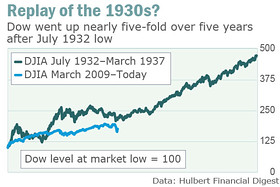
Another rally that is perhaps more comparable is the one that began in July 1932. It lasted nearly five years, and during it the Dow more than quadrupled.
The accompanying chart superimposes on that mid-1930s rally the Dow’s progress from the March 9, 2009, low until now. Within the acceptable tolerances of analogy-drawing, I’d say the market over the last two and one-half years is not that far off.
And, if this is the script the market is indeed playing out, a huge rally is in store over the next couple of years.
Is this analogy-drawing little more than shameless data mining? Probably not. I engage in it for this column simply to counter those who, equally shamelessly, try drawing their own analogies to the 1930s in order to reach bearish conclusions.
From a contrarian perspective, however, the analogies to that decade that the bears love to draw do have significance. It indicates just how robust is the wall of worry that advisers choose to draw an analogy to the very worst of the 1930s — when they just as easily could do so in another way and reach a quite bullish conclusion.
And, as we all know, bull markets like to climb a wall of worry.
~ Mark Hulbert, "Is stock market replaying decade of the 1930s?," MarketWatch.com, September 23, 2011
Sep 7, 2011
Robert Wenzel on Nouriel Roubini, central bank propagandist
Nouriel Roubini is either ignorant of financial history, or attempting to keep the populace ignorant. Roubini should stop tweeting on history until he is willing to tweet the facts. The rest of us should continue to study history so that we will be aware when central bank propagandists are attempting to distort history in front of our very own eyes.
~ Robert Wenzel, "Roubini's Off the Wall History of Financial Crashes," Economic Policy Journal, August 21, 2011
~ Robert Wenzel, "Roubini's Off the Wall History of Financial Crashes," Economic Policy Journal, August 21, 2011
Thomas Sowell on the price system
Prices are important not because money is considered paramount but because prices are a fast and effective conveyor of information through a vast society in which fragmented knowledge must be coordinated.
~ Thomas Sowell
Sep 5, 2011
Marc Benioff compares legacy enterprise companies to Arab dictators
In the Arab revolution] you didn't see signs saying 'Thank you Microsoft.' You didn't see signs saying 'thank you IBM.' ... We've seen Mubarak fall, Qaddafi fall. Not so long from now we'll hear about a corporate spring, an enterprise spring. When will the first corporate CEO fall for the same reason -- because customers are rising up, they're not listening to their employees, they're not paying attention.
~Marc Benioff, CEO, Salesforce.com, speech delivered at Salesforce.com's "Dreamforce" conference, August 31, 2011
~Marc Benioff, CEO, Salesforce.com, speech delivered at Salesforce.com's "Dreamforce" conference, August 31, 2011
Subscribe to:
Posts (Atom)
