Showing posts with label books - The Fatal Conceit. Show all posts

Dec 19, 2021

Friedrich Hayek on how socialism threatens civilization

The demands of socialism are not moral conclusions derived from the traditions that formed the extended order that made civilisation possible.  Rather, they endeavour to overthrow these traditions by a rationally designed moral system whose appeal depends on the instinctual appeal of its promised consequences.  They assume that, since people had been able to generate some system of rules coordinating their efforts, they must also be able to design an even better and more gratifying system.  But if humankind owes its very existence to one particular rule-guided form of conduct of proven effectiveness, it simply does not have the option of choosing another system merely for the sake of the apparent pleasantness of its immediately visible effects.  The dispute between the market order and socialism is no less than a matter of survival.  To follow socialist morality would destroy much of present humankind and impoverish much of the rest.

~ Friedrich Hayek, The Fatal Conceit


Jul 28, 2020

Friedrich Hayek on how historians are overly impressed with powerful states

Nothing is more misleading... than the conventional formulae of historians who represent the achievement of a powerful state as the culmination of cultural evolution: it often marked its end.

~ Friedrich Hayek, The Fatal Conceit

Apr 29, 2020

Friedrich Hayek on how uniqueness allows for specialization and "a more successful use of the earth's resources"

It is... not simply more men, but more different men, which brings an increase in productivity.  Men have become powerful because they have become so different: new possibilities or specialisation - depending not so much on any increase in individual intelligence but on growing differentiation of individuals - provide the basis for a more successful use of the earth's resources.

~ Friedrich Hayek, The Fatal Conceit, Chapter 8: "The Extended Order and Population Growth"

5.5 Negotiation Concepts Worth Knowing — CareerMetis.com

Apr 27, 2020

Friedrich Hayek on the appropriation of the term "liberal" by socialists

[T]here was the deliberate deception practiced by American socialists in their appropriation of the term 'liberalism.'  As Joseph A. Schumpeter rightly put it" 'As a supreme if unintended compliment, the enemies of the system of private enterprise have thought it wise to appropriate its label.'  The same applies increasingly to European political parties of the middle, which either, as in Britain, carry the name liberal or, as in West Germany, claim to be liberal but do not hesitate to form coalitions with openly socialist parties.  It has, as I complained over twenty-five years ago (1960, Postscript), become almost impossible for a Gladstonian liberal to describe himself as a liberal without giving the impression that he believes in socialism.  Nor is this a new development: as long ago as 1911, L.T. Hobhouse published a book under the title Liberalism that would more correctly have been called Socialism, promptly followed by a book entitled The Elements of Social Justice (1922).

~ Friedrich Hayek, The Fatal Conceit, Chapter 6

What kind of a liberal are you? | Classical Liberalism vs. Modern ...

Apr 25, 2020

Friedrich Hayek on government management of money

The history of government management of money has, except for a few short happy periods, been one of incessant fraud and deception.  In this respect, governments have proved far more immoral than any private agency supplying distinct kinds of money in competition possibly could have been.

~ Friedrich Hayek, The Fatal Conceit, Chapter 6

Most Libertarians Don't Understand Friedrich Hayek, Says Peter ...

Apr 23, 2020

Friedrich Hayek on how trade requires diversity

Exchange is productive; it does increase the satisfaction of human needs from available resources.  Civilisation is so complex - and trade so productive - because the subjective worlds of the individuals living in the civilised world differ so much.  Apparently paradoxically, diversity of individual purposes leads to a greater power to satisfy needs generally than does homogeneity, unanimity and control - and, also paradoxically, this is so because diversity enables men to master and dispose of more information.  Only a clear analysis of the market process can resolve these apparent paradoxes.

~ Friedrich Hayek, The Fatal Conceit, Chapter 6: "The Mysterious World of Trade and Money"

Apr 22, 2020

Friedrich Hayek on the task of economics

The curious task of economics is to demonstrate to men how little they really know about what they imagine they can design.

~ Friedrich Hayek, The Fatal Conceit

Apr 20, 2020

Friedrich Hayek on intellectuals and their hostility towards the free market

This reluctance [to integrate themselves into the marketplace] helps further to explain the hostility intellectuals bear towards the market order, and something of their susceptibility to socialism.  Perhaps this hostility and susceptibility would diminish if such persons understood better the role that abstract and spontaneous ordering patterns play in all of life, as they no doubt would do if better informed of evolution, biology, and economics.  But when confronted by information in these fields, they are often reluctant to listen, or even to consider conceding the existence of complex entities of whose working our minds can have only abstract knowledge.

~ Friedrich Hayek, The Fatal Conceit, Chapter 5: "The Fatal Conceit"

Apr 19, 2020

Friedrich Hayek on the dispersion of knowledge, variety and the division of labor

The knowledge that plays probably the chief role in this differentiation [Wilhelm von Humboldt's "human development in its richest form"] - far from being the knowledge of any one human being, let alone that of a directing superbrain - arises in a process of experimental interaction of widely dispersed, different and even conflicting beliefs of millions of communicating individuals.  The increasing intelligence shown by man, accordingly, due not so much to increases in the several knowledge of individuals but to procedures for combining different and scattered information which, in turn, generate order and enhance productivity.

Thus the development of variety is an important part of cultural evolution, and a great part of an individual's value to others is due to his differences from them.  The importance and value of order will grow with the variety of the elements, while greater order in turn enhances the value of variety, and thus the order of human cooperation becomes indefinitely extensible.  If things were otherwise, if for example all men were alike and could not make themselves different from one another, there would be little point in division of labour..., little advantage from coordinating efforts, and little prospect of creating order of any power or magnitude.

~ Friedrich Hayek, The Fatal Conceit, Chapter 5: "The Fatal Conceit"
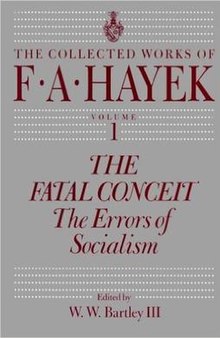
The Fatal Conceit.jpg

Apr 18, 2020

Friedrich Hayek on how knowledge is dispersed

To the naive mind that can conceive of order only as the product of deliberate arrangement, may seem absurd that in complex conditions order, and adaptation to the unknown, can be achieved more effectively by decentralising decisions, and that a division of authority will actually extend the possibility of overall order.  Yet that decentralisation actually leads to more information being taken into account.  This is the main reason for rejecting the requirements of constructivist rationalism [socialism].  For the same reason, only the alterable division of the power of disposal over particular resources among many individuals actually able to decide on their use - a division attained through individual freedom and several property - makes the fullest exploitation of dispersed knowledge possible.

~ Friedrich Hayek, The Fatal Conceit, p. 76

Apr 14, 2020

Friedrich Hayek on and profit and loss

As we now know, in the evolution of the structure of human activities, profitability works as a signal that guides selection towards what makes man more fruitful; only what is more profitable will, as a rule, nourish more people, for it sacrifices less than it adds.

~ Friedrich Hayek, The Fatal Conceit (1988), Chapter 3: "The Evolution of the Market", p. 46

Friedrich August Hayek - Econlib

Apr 11, 2020

Edmund Burke on the preconditions of liberty

Men are qualified for civil liberties, in exact proportion to their disposition to put moral chains upon their appetites: in proportion as their love of justice is above their rapacity.

~ Edmund Burke

(From Chapter 2 of Friedrich Hayek's The Fatal Conceit.)

The Portable Edmund Burke by Edmund Burke: 9780140267600 ...

Apr 9, 2020

Friedrich Hayek on the civilized and beastly characteristics of man

Yet so far as we know, all currently civilised groups appear to possess a similar capacity for acquiring civilisation and culture by learning certain traditions.  Thus it hardly seems possible that civilisation and culture are genetically determined and transmitted.  They have to be learnt by all alike through tradition.

[...]

This gradual replacement of innate responses by learnt rules increasingly distinguished man from other animals, although the propensity to instinctive mass action remains one of the several beastly characteristics that man has retained.

~ Friedrich Hayek, The Fatal Conceit

9781138418943: The Fatal Conceit: The Errors of Socialism ...