Showing posts with label creative destruction. Show all posts

May 14, 2025

Wayne Winegarden and Rowena Itchon on creative destruction

International trade, like all productive contributions to economic growth, is a creatively destructive process that improves our lives by disrupting the old way of doing things.  While necessary to generate broad-based prosperity, these disruptions are not without a cost.  The growth in internet retailers, for instance, has brought a wider array of more affordable goods and services directly to people’s doorsteps around the world.  Between 2007 and 2017, it also created nearly a half million new jobs in fulfillment centers and e-commerce companies in the U.S. alone that paid nearly a third more than brick-and-mortar retail jobs on average.  While the job gains in the new economy also caused job losses and business closings for brick-and-mortar retailers, on net, e-commerce has vastly improved our quality of life.

~ Wayne Winegarden and Rowena Itchon, “Free Trade Myths and RealitiesFree Trade in the Twenty-First Century, pp. 643-644


Kevin Duffy on Walter Williams

As a younger man, I had the privilege of hearing the late free market economist, Walter Williams, speak.  “People are worried about saving jobs, but as an economist, I get excited when jobs are destroyed,” he told the audience.  “Should we bemoan the invention of the dishwashing machine because it puts dish washers out of work?  There are an infinite number of jobs. Just come to my house this weekend and I’ll prove it to you.”

~ Kevin Duffy, "Mercantilism in America," The Coffee Can Portfolio, May 6, 2025


Apr 22, 2025

Tom Woods on creative destruction and human progress

I think everybody has to acknowledge, if we're being realistic about this, that any kind of free economy is going to have that outcome [winners and losers] because there will always be new developments.  There will be changes in peoples' tastes, preferences, resource availability, all kinds of things that change on a dime.  As Mises said, "We all, on some level, recognize that in order to get to the standard of living that we had, some things had to go by the wayside because they were taking up resources that were better used for other things."  But when we are involved with the thing that has to go by the wayside, we consider it the greatest injustice in mankind's history.  

But we all know on some level that if we don't do that, then we would be, let's see, we would be sitting in a society overflowing with rotting food because we would be producing so much, we couldn't consume it all, we'd still have the sanitary problem of horse fecal material all over the streets because we would be transported that way.  There are big changes that come in any kind of free economy, whether or not you have free trade.  And the thing is, in general, that works out for everybody.  But it can mean short-term displacement for some people.  You can try to mitigate that through social welfare and voluntary contributions and various services you can provide, but you would never want to just simply stop it because that's the way progress occurs.  That's the way progress that we all want occurs.

~ Tom Woods, "Is China Guilty As Charged?," 38:00 mark, The Tom Woods Show, April 18, 2025


Jul 1, 2021

Steve Forbes on the role of profit (and the contrasting views of Adam Smith and Joseph Schumpeter)

Smith, Marx and Keynes all believed in various ways in what you might call an equilibrium, that the economy is a steady state and you get disruptions from time to time, whether wars, earthquakes or new inventions.  You get some turmoil and then things settle down and you have an equilibrium, which is why even John Stuart Mill became a socialist (not because of the influence of his young wife).  He couldn’t understand the role of profit. 

Even Adam Smith did not understand the role of profit.  If you have an economy where you are striving for a perfectly competition equilibrium, there is no role for profit, other than as a bribe for entrepreneurs to do things.  Schumpeter was an infidel, in the words of Peter Drucker.  That is, he saw profit as a cost of doing business, as a moral force.  Why?  Because in his mind the economy is always dynamic.  A free market is dynamic, always changing, what he called creative destruction.  You focus on the creative side.  But it’s also destroying, which means it’s destroying capital and you have to replace that destroyed capital with new capital. 

Also, how does an economy advance?  It advances with new knowledge.  Where does knowledge come from?  Through constant experimentation by entrepreneurs in the marketplace.  Look at Silicon Valley.  Look at Peter Thiel.  He says eight out of ten ventures, even with great brains like his, will fail.  Only two out of ten, maybe one out of ten, will really be successful. 

So, profit is essential if you’re going to have a growing economy.


Jul 11, 2019

Joseph Schumpeter on capitalism and creative destruction

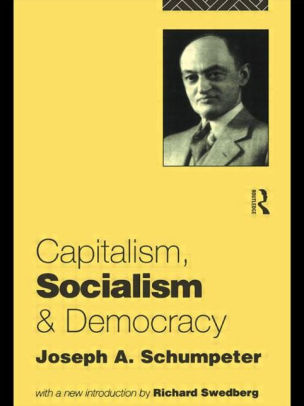
The opening up of new markets, foreign or domestic, and the organisational development from the craft shop and factory to such concerns as US Steel illustrate the same process of industrial mutation – if I may use that biological term – that incessantly revolutionises the economic structure from within, incessantly destroying the old one, incessantly creating a new one. This process of Creative Destruction is the essential fact about capitalism.

~ Joseph Schumpeter, Capitalism, Socialism and Democracy (1942)

Capitalism, Socialism and Democracy / Edition 6

Jul 4, 2019

George Gilder on economic conflict

The crucial conflict in every economy... goes on.  It is not between rich and poor, Main Street and Wall Street, or even government and the private sector.  It is between the established system and the new forms of wealth rising up to displace it - all the entrenched knowledge of the past and the insurrections of futuristic enterprise and invention.

~ George Gilder, "The Coming Creativity Boom," Forbes, November 10, 2008

Feb 5, 2017

The New York Times: "A taxi medallion is comparable to buying an apartment in Manhattan" (2011)

A taxi medallion is comparable to buying an apartment in Manhattan. It will always make good money and pay for itself.

~ The New York Times, 2011