~ Kumal Kapoor, Morningstar, Barron's interview, February 20, 2025
Showing posts with label active vs. passive investing. Show all posts
Feb 20, 2025
Kumal Kapoor on the importance of low fees when choosing a fund
I don't think it's a passive vs. active debate... Ironically, even Vanguard's active funds are quite good. And the reason they are is because they're low fee. So if you parse our data, what you find in public markets is it's less about "Is active winning or is passive winning?" It's really about low cost is beating the heck out of high cost, including in the active space.
Nov 17, 2024
Richard Lawrence on active investing
We're just going to keep doing what we're doing. There's no real reason for us to change. My dad was a stockpicker, John Bush [my mentor] was a stockpicker, I'm a stockpicker, my younger colleagues are stockpickers. In 20 years, the world is going to need stockpickers. The financial market, Wall Street, might want to turn us all into obsolete things with AI and ETFs and whatnot, but I can tell you it's not going to happen.
~ Richard Lawrence, "Betting Big on China & Lessons from Bear Markets," We Study Billionaires, 1:11:20 mark, September 19, 2024
Oct 25, 2024
Kevin Duffy on the passive bubble
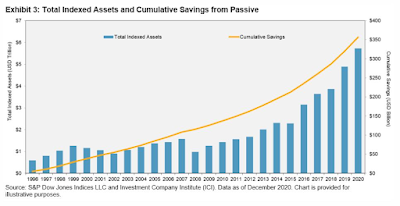
Over [the past 10 years], a staggering $6.0 trillion has poured into passively managed funds, with $2.3 trillion pulled from active funds.
~ Kevin Duffy, "Fade to Black," The Coffee Can Portfolio, p. 10, October 22, 2024
Jul 10, 2024
Whitney Tilson on holding on to winning stocks
Almost no human being has the ability to do this. If you want to know the main reason index funds outperform almost all active managers over a long period of time, it's because they never sell their winners. They let their winners run. Just look at the S&P 500 index. The S&P 500 index has never sold a share of Apple, Nvidia, Microsoft, Berkshire Hathaway, Visa, Mastercard, Lilly. I just named almost all the top 10 stocks in the S&P that drive its entire return.
~ Whitney Tilson, "Be Greedy and Let Your High-Quality Winners Run," Stansberry Investor Hour, 26:35 mark, July 8, 2024
May 10, 2024
Grant Williams on UK stocks and the return of active investing
There are some phenomenal companies in the UK, no doubt about it. And as you said, it's an equity market that's been there forever. So given the fact that it's fallen so far behind, there is definitely opportunity in the UK. But I think the important thing to understand here is - this comes back to another trend that I've been looking at - the idea of having to do less to be more successful, i.e. we talked about the bitcoin ETF. It would be easy from this part of our conversation to say that "oh, the UK's cheap, I'm going to buy the UK." And that is kind of where we've come to. We buy these abstract ideas. We buy countries.
We used to buy companies. We used to buy a share in a business. And now we buy stocks. And the difference in mindset for that is extraordinary because if you're buying a stock, you just own a number and you're buying it because it's going to go up. You haven't done the work to understand the business, you haven't gone into it feeling like an owner of a series of cash flows, which is what this used to be all about. And it changes your mindset. You're not a long-term holder; we've seen that the average holding time data and how that's cratered in the last 20 years.
Again, I believe this is a change in mindset that I suspect is going to start to come back the other way, i.e. if you do want to make money in UK stocks, you will be able to make some terrific money in UK stocks, but the tradeoff is you're going to have to go back to work again. You're going to have to sit there and start to find individual companies instead of buying the UK ETF if you want to outperform. And I think that's a great thing, to be honest with you. It will bring back the talents of these extraordinary managers who've been marginalized by ETFs and the Vanguards and BlackRocks of the world. And the idea that you make money by working hard, I mean what a great idea that is. What a great idea. And to Peter [Atwater's] point about luxury, it's the antithesis of that. It's not "we deserve to make money in the stock market," it's "we're going to have to work to earn money in the stock market." And that to me is where this will always come back to over time when the froth of the entitlement dissipates.
Apr 22, 2024
Savita Subramanian on the brain drain from active equity investing
My thesis is we've seen a brain drain from active public equity investors to private equity or passive. That public equity component has been squeezed out by either reaching for growth in private equity - and that's where people are looking for their long-term fundamental exposure - or they're getting low-cost and moving to passive index funds for exposure to the S&P 500.
I think there are massive inefficiencies in the public equity market right now that haven't necessarily been sussed out by expert stockpickers.
~ Savita Subramanian, "Markets Aren't as Efficient as They Seem. Look Closer.," Barron's, February 17, 2024
Apr 21, 2024
Patti Domm on the decline of active investing
In 2000, pensions had about 80% of their equity allocation in active public equities. That has shrunk to about a third of overall equity allocation, with holdings in private equity and passive investments also at about a third each, [BofA Global Research strategist Savita] Subramanian says.
The mutual fund world has also seen big changes. The number of funds in U.S., long-only, large-cap funds has dropped by 40% since 2013, found BofA Global Research.
[...]
The average number of sell-side analysts covering an S&P 500 stock has fallen by 15% from a peak at the start of 1990, according to BofA.
~ Patti Domm, "Markets Aren't as Efficient as They Seem. Look Closer.," Barron's, February 17, 2024
Apr 11, 2024
The Economist on the decline of active investing
The clearest casualty of passive funds has been active managers... During the past decade the number of active funds has declined by 40%. According to Bank of America, since 1990 the average number of analysts covering firms in the S&P 500 index has dropped by 15%. Their decline means fewer value-focused soldiers guarding market fundamentals.
[...]
For the time being, at least, passive investors have the upper hand. And unless the concentration of America's stockmarket decreases, it seems unlikely that the fortunes of active managers will truly reverse.
~ "Too efficient: Having killed off stockpickers, are passive funds behind market mania?," The Economist, March 2, 2024
Jan 29, 2023
Kevin Duffy on active investing
2022 was the year for active investing to shine. Quantifying the opportunity set for active managers is difficult, but one attempt is to compare the Equal-weighted S&P 500 (RSP) to the Float-weighted S&P 500 (SPY). Last year, RSP outperformed SPY by 6.56% after a long stretch of underperformance.
Retail investors are convinced a change is not at hand. In fact, they poured $278 billion into passive U.S. equity funds last year, pulling $232 billion from active U.S. equity funds. Over the past five years, over $1 trillion has been yanked from active U.S. equity managers and placed in low-cost index funds. (Passive now accounts for 58% of assets in the category.) In other words, the index pond is overrun with fishermen and largely depleted. Across the index divide, multiple lakes and streams are full of fish, but practically empty.
~ Kevin Duffy, The Coffee Can Portfolio, pp. 18-19, January 24, 2023
Dec 27, 2020
Mike Green on how passive investing is distorting capital allocation
That is actually a very important role: taking money from bad companies and giving it to good companies is a critical role in the capitalist system, effectively allowing those who are efficient and intelligent allocators of capital, to give money to management teams that have good prospects in terms of generating future wealth. What we've created now is a distortion that's a funhouse mirror effect, right? Where we've presumed everyone is doing this for us where it is a fool's game to do it for ourselves.
~ Mike Green, "Why The Rise of Passive Investing Might Be Distorting The Market," Odd Lots podcast with Joe Weisenthal and Tracy Alloway, January 23, 2020
May 4, 2020
Bloomberg Businessweek: "Bashing Big Tech now looks as dated as a handshake" (2020)
In a crisis, large companies can have an edge. As the pandemic has forced the shuttering of local stores and restaurants, grounded consumers streamed Tiger King on Netflix, stocked up on groceries and supplies from Amazon, and gathered together on Zoom. Hardly and company is immune from the economic shutdown, but the big ones have more resources to weather the pandemic and, in some cases, may be able to gain market share.
On Wall Street, that's exacerbating a divergence between small and large companies which has been frustrating stockpickers for some time. The Russell 2000, a benchmark for small companies, has lagged the big-name S&P 500 index badly over the past two years. This year the small stocks, with a median market valuation of about $525 million, have lost 22% as of April 28; the S&P, about half of that. The Nasdaq 100, which tracks the largest tech stocks, is down less than 1%. The S&P 500's companies now make up 82% of the entire U.S. stock market's value, a share that's been steadily rising this century.
None of that is good news for active fund managers...
[I]t's easy to see the pandemic continuing to entrench some advantages of size. Bashing Big Tech now looks as dated as a handshake, and Silicon Valley's giants may be able to expand their clout. Large companies can also find it easier to tap credit and solve supply chain problems.
~ Bloomberg Businessweek, "How Quants Got Bullied," May 4, 2020
On Wall Street, that's exacerbating a divergence between small and large companies which has been frustrating stockpickers for some time. The Russell 2000, a benchmark for small companies, has lagged the big-name S&P 500 index badly over the past two years. This year the small stocks, with a median market valuation of about $525 million, have lost 22% as of April 28; the S&P, about half of that. The Nasdaq 100, which tracks the largest tech stocks, is down less than 1%. The S&P 500's companies now make up 82% of the entire U.S. stock market's value, a share that's been steadily rising this century.
None of that is good news for active fund managers...
[I]t's easy to see the pandemic continuing to entrench some advantages of size. Bashing Big Tech now looks as dated as a handshake, and Silicon Valley's giants may be able to expand their clout. Large companies can also find it easier to tap credit and solve supply chain problems.
~ Bloomberg Businessweek, "How Quants Got Bullied," May 4, 2020
Feb 22, 2020
Kevin Duffy on the passive bubble vs. active anti-bubble
Besides bonds, there is plenty of herding into private investments by the wealthy, especially venture capital and private equity. Away from the top 1%, the obvious crowding is into passive investing. After a decade when U.S. large cap stocks outperformed most active managers, the typical investor is pouring money into funds that mimic an index, like the S&P 500, that charge very little in fees.
While I applaud being frugal and holding active managers’ feet to the fire, the crowd is very likely looking in the rearview mirror at this point. In general, stocks in the S&P 500 have become quite expensive while many across the “index divide” are actually fairly cheap. The latter area is where we need to hunt for bargains.
~ Kevin Duffy, The Coffee Can Portfolio, February 18, 2020
While I applaud being frugal and holding active managers’ feet to the fire, the crowd is very likely looking in the rearview mirror at this point. In general, stocks in the S&P 500 have become quite expensive while many across the “index divide” are actually fairly cheap. The latter area is where we need to hunt for bargains.
~ Kevin Duffy, The Coffee Can Portfolio, February 18, 2020
Subscribe to:
Posts (Atom)