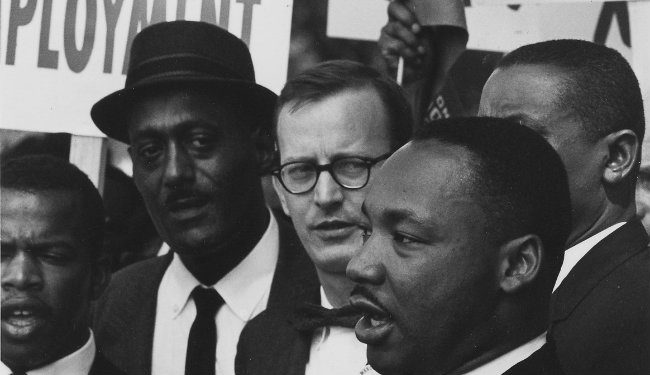
~ Eric Hoffer, The Passionate State Of Mind, and Other Aphorisms, Section 42, 1955
Showing posts with label welfare. Show all posts
Oct 19, 2021
Eric Hoffer: "Power corrupts the few, while weakness corrupts the many"
It has often been said that power corrupts. But it is perhaps equally important to realize that weakness, too, corrupts. Power corrupts the few, while weakness corrupts the many. Hatred, malice, rudeness, intolerance, and suspicion are the faults of weakness. The resentment of the weak does not spring from any injustice done to them but from their sense of inadequacy and impotence. We cannot win the weak by sharing our wealth with them. They feel our generosity as oppression.
Labels:
corruption,
human weaknesses,
people - Hoffer; Eric,
power,
welfare,
welfare state
Aug 1, 2021
George Bernard Shaw on welfare
A government that robs Peter to pay Paul can always depend on the support of Paul.
~ George Bernard Shaw
Labels:
government,
people - Shaw; George Bernard,
theft,
welfare
Jul 26, 2021
Thomas Sowell on fairness
Since this is an era when many people are concerned about "fairness" and "social justice," what is your "fair share" of what someone else has worked for?
~ Thomas Sowell
Labels:
fairness,
people - Sowell; Thomas,
social justice,
welfare
Jul 2, 2021
May 10, 2021
Sam Zell on welfare incentives not to work
We've created a welfare society that is really discouraging people [from working]. When you can make as much or more by collecting unemployment insurance, and supplemental this and supplemental that, that's pretty dangerous stuff. Clearly, we're having trouble getting everybody back into the workforce because the alternative is so attractive.
~ Sam Zell, "Sam Zell Buys Gold With Inflation ‘Reminiscent of the ‘70s’," Bloomberg interview, 2:25 mark, May 4, 2021
Labels:
employment,
people - Zell; Sam,
unemployment,
welfare,
welfare state
Oct 31, 2020
Ben Franklin on poverty
I think the best way of doing good to the poor, is not making them easy in poverty, but leading or driving them out of it.
~ Ben Franklin
Brad Polumbo on generous unemployment benefits to counter Covid lockdowns
Trapping more people in a state of government dependency isn’t generous—and it isn’t sustainable. It’s cruel.
~ Brad Polumbo, "Why Responding to the COVID Poverty Spike With More Welfare is Cruel, Not Generous," FEE.org, October 27, 2020
Oct 1, 2020
Jason Riley on the history of black poverty and the family in America
Jason Riley: Let's look at poverty. Between 1940 and 1960, black poverty in America fell by 40 percentage points... in 20 years. That's before the Civil Rights Act, before Voting Rights Act, before Brown v. Board of Education... Now it continued to fall through the '70s and '80s, but at a much slower rate. You had a much stronger black family coming out of slavery, throughout Reconstruction, into Jim Crow. Two parent households were much more likely among blacks than what you have today. And in some years, according to census, two parent households... the rate exceeded that of whites. The difference today, and I would argue largely as a result of these efforts to help blacks, you have seen the disintegration of the black family. And until blacks repair that damage - and there is significant damage there - I don't see how these other outcomes are going to improve.
Nick Gillespie: What can the government do?
Riley: It's not about what I want the government to do; it's what I want the government to stop doing. Stop raising the minimum wage and pricing blacks out of the labor force. Stop mismatching kids with schools in the form of affirmative action and setting them up to fail. Stop trying to replace a father in the home with a government check.
~ Jason Riley, "Black Americans Failed by Good Intentions: An Interview with Jason Riley," 5:38 mark, Reason TV, September 3, 2014
Sep 22, 2020
Thomas Sowell on immigration
When only 2% of immigrants from Japan to the United States go on welfare, while 46% of the immigrants from Laos do, there is no single pattern that applies to all immigrants. Everything depends on which immigrants you are talking about and which periods of history.
~ Thomas Sowell, Basic Economics (2000)
Labels:
immigration,
Japan,
Laos,
people - Sowell; Thomas,
welfare
Sep 10, 2020
Walter Williams on poverty, responsibility and welfare
The poverty we have today is spiritual poverty.
Spiritual poverty is an absence of what traditionally has been known as various human virtues. Much of that spiritual poverty is a result of public and private policy that rewards inferiority and irresponsibility. Chief among the policies that reward inferiority and irresponsibility is the welfare state. When some people know they can have children out of wedlock, drop out of school and refuse employment and suffer little consequence and social sanction, one should not be surprised to see the growth of such behavior. Today’s out-of-wedlock births among blacks is over 70%, but in the 1930s, it was 11%. During the same period, out-of-wedlock births among whites was 3%; today, it is over 30%. It is fashionable and politically correct to blame today’s 21% black poverty on racial discrimination. That is nonsense. Why? The poverty rate among black husband-and-wife families has been in the single digits for more than two decades. Can anyone produce evidence that racists discriminate against black female-headed families but not black husband-and-wife families?

~ Walter Williams, "Today and Yesterday," LewRockwell.com, September 10, 2020
Sep 7, 2020
Calvin Coolidge on redistribution schemes
Don't expect to help the weak by pulling down the strong.
~ Calvin Coolidge

~ Calvin Coolidge
Labels:
people - Coolidge; Calvin,
socialism,
tax the rich,
welfare
Jun 4, 2020
Jordan Weissmann on MLK's economic dream
So what, exactly, was the reverend's economic dream? In short, King wanted the government to eradicate poverty by providing every American a guaranteed, middle-class income—an idea that, while light-years beyond the realm of mainstream political conversation today, had actually come into vogue by the late 1960s.
~ Jordan Weissmann, "Remembering Martin Luther King, Jr.'s Solution to Poverty," The Atlantic, January 20, 2014
Mar 19, 2020
Dan Ferris on government safety nets
When the government has your back your spine goes limp.
~ Dan Ferris, tweet, @dferris1961, March 19, 2020
Labels:
bailouts,
moral hazard,
people - Ferris; Dan,
welfare
Jan 2, 2020
Kevin Duffy on why welfare schemes fail
Q: If a conservative or libertarian believes the individual is better suited to make economic and financial decisions than big government or corporations, why then are they opposed to UBI, which recirculates wealth to individuals?
A: Welfare schemes don’t “recirculate wealth to individuals.” They take property from some individuals to give to others. The former group has accumulated wealth through hard work, vision, pluck and sometimes luck, but overwhelmingly by peaceful and voluntary means. These are the most productive members of society and the best stewards of capital. Transferring any portion of their wealth to the poorest stewards of capital (especially politicians and their bureaucracies) can only shrink the economic pie.
Ironclad law of economics: Tax a certain behavior and you get less, subsidize a certain behavior and you get more…
~ Kevin Duffy, Quora answer, December 26, 2019

A: Welfare schemes don’t “recirculate wealth to individuals.” They take property from some individuals to give to others. The former group has accumulated wealth through hard work, vision, pluck and sometimes luck, but overwhelmingly by peaceful and voluntary means. These are the most productive members of society and the best stewards of capital. Transferring any portion of their wealth to the poorest stewards of capital (especially politicians and their bureaucracies) can only shrink the economic pie.
Ironclad law of economics: Tax a certain behavior and you get less, subsidize a certain behavior and you get more…
~ Kevin Duffy, Quora answer, December 26, 2019

Jan 1, 2020
Rutherford B. Hayes anticipates the modern welfare state
No man, however benevolent, liberal, and wise, can use a large fortune so that it will do half as much good in the world as it would if it were divided into moderate sums and in the hands of workmen who had earned it by industry and frugality. The piling up of estates often does great and conspicuous good.... But no man does with accumulated wealth so much good as the same amount would do in many hands.
~ Rutherford B. Hayes, 19th president
| Rutherford B. Hayes 1922-1925 |
Oct 27, 2019
Penn Jillette on the difference between welfare and charity
It's amazing to me how many people think that voting to have the government give money to poor people is compassion. Helping poor and suffering people yourself is compassion. Voting for government to use guns to give money to help poor and suffering people is immoral self-righteous bullying laziness. People need to be fed, medicated, educated, clothed, and sheltered. If we're compassionate, we'll help them, but you get no moral credit for forcing other people to do what you think is right. There is great joy in helping people, but no joy in doing it at gunpoint.
~ Penn Jillette

~ Penn Jillette
May 28, 2017
Rose Wilder Lane: Can individualism survive in the U.S.?
There is nothing new in planned and controlled economy. Human beings have lived under various forms of that social security for six thousand years. The new thing is the anarchy of individualism, which has been operating freely only in this country for a century and a half.
When I first wrote this book ten years ago, I asked myself whether individualism has enough social vitality to survive in a world turning back to the essentially medieval, static forms. Can individualism, which by its very nature has no organization and no leader, stand against the determined attack of a small group, organized, controlled, and fanatically sure that a strong man in power can give a people better lives than they can create for themselves?
The spirit of individualism is still here. There are some 130,000,000 human beings in these United States, and not one of us has escaped anxiety, and very few of us have not been forced to reduce our standard of living during these past few years. The number of us who have been out of work and facing actual hunger is not known; the largest estimate has been twelve million. Of this number, barely a third appeared on the reported relief rolls. Somewhere those millions in need of help, who were not helped, are still fighting through this depression on their own.
Millions of farmers are still lords on their own land; they are not receiving checks from the public funds to which they contribute their increasing taxes.
Millions of men and women have quietly been paying debts from which they asked no release; millions have cut expenses to the barest necessities, spending every dime in fear that soon they will have nothing, and somehow being cheerful in the daytime and finding God knows what strength or weakness in themselves during the black nights.
Americans are still paying the price of individual liberty, which is individual responsibility and insecurity.
~ Rose Wilder Lane, "Give Me Liberty," 1944 (first published in 1936)
When I first wrote this book ten years ago, I asked myself whether individualism has enough social vitality to survive in a world turning back to the essentially medieval, static forms. Can individualism, which by its very nature has no organization and no leader, stand against the determined attack of a small group, organized, controlled, and fanatically sure that a strong man in power can give a people better lives than they can create for themselves?
The spirit of individualism is still here. There are some 130,000,000 human beings in these United States, and not one of us has escaped anxiety, and very few of us have not been forced to reduce our standard of living during these past few years. The number of us who have been out of work and facing actual hunger is not known; the largest estimate has been twelve million. Of this number, barely a third appeared on the reported relief rolls. Somewhere those millions in need of help, who were not helped, are still fighting through this depression on their own.
Millions of farmers are still lords on their own land; they are not receiving checks from the public funds to which they contribute their increasing taxes.
Millions of men and women have quietly been paying debts from which they asked no release; millions have cut expenses to the barest necessities, spending every dime in fear that soon they will have nothing, and somehow being cheerful in the daytime and finding God knows what strength or weakness in themselves during the black nights.
Americans are still paying the price of individual liberty, which is individual responsibility and insecurity.
~ Rose Wilder Lane, "Give Me Liberty," 1944 (first published in 1936)
Labels:
individualism,
people - Lane; Rose Wilder,
welfare
Nov 16, 2016
Clifford Thies on the 19th century private welfare system vs. the 20th century welfare state
The 19th century welfare system was privately supplied, much more efficient, and more compassionate, for society as well as the poor. Instead of giving away cash and other benefits, it mandated work and responsibility. In the 19th century, the poor were divided into three groups: 1) those who worked and were given supplemental assistance
through private charity; 2) those who were manifestly incapable of working and who were sent into poorhouses; and 3) those who were capable of working but refused to do so. The latter were called “paupers,” people who lived from hand-to-mouth, and were drifters, alcoholics, beggars, and thieves. The social welfare system effectively (although not of course perfectly) identified them as the undeserving poor and denied them help. Through poorhouses, and other extremely limited programs, charity provided only for those manifestly unable to work. Poorhouses were usually private institutions, sometimes no more than a family with a large house, which, for a fee, took care of the mentally and physically ill, the enfeebled aged, and orphans who could not be placed for adoption. Conditions in those poorhouses were minimal (although better than depicted by the left-wing Charles Dickens). Accordingly, the able-bodied poor tried to stay out of the poorhouse.
[…]
Going to the poorhouse meant trading liberty for subsistence… The stark terms of the deal offered by the poorhouse was no bargain, as was intended… Private charities demanded that those would could work, do so. Their programs were not “anti-poverty” but “anti-pauper.”
[…]
Very few single women were able to raise their children without continuing help, and most eventually married. At the same time, however, the case of unwed motherhood led to a decoupling of welfare and work. In 1911 Illinois adopted the first “mothers’ aid” program and by 1928, 42 states, the District of Columbia, and Alaska and Hawaii had followed this lead. Modest at first, they made a step towards replacing the 19th century, work-based philosophy with a new “scientific,” income-based one. Today, income is no longer dependent on work, nor is assistance based on charity. There is no distinction between the deserving and the undeserving poor. There is no effort to provide the proper incentives. But this should be no surprise. By its nature, government is unable to do much more than dish out money to people who meet the standards set by the application process, regardless of their intent or prospects. Press group politics, moreover, has turned a permanent income combined with perpetual laziness into a civil right.
[…]
Government welfare has encouraged the worst vices of the poor, turning even able-bodied people into drifters, alcoholics, drug addicts, beggars, and thieves. In short, the poor have become paupers, the group the 19th century charity theorists identified as not deserving of support… In fact, the situation is much worse than the 19th century charity theorists predicted. The primary victims, ironically, have been unmarried mothers and their children, the supposed beneficiaries of the early 20th century reform movement.
~ Clifford F. Thies, "Bring Back the Poorhouse and the Workhouse," The Free Market, October 1992

[…]
Going to the poorhouse meant trading liberty for subsistence… The stark terms of the deal offered by the poorhouse was no bargain, as was intended… Private charities demanded that those would could work, do so. Their programs were not “anti-poverty” but “anti-pauper.”
[…]
Very few single women were able to raise their children without continuing help, and most eventually married. At the same time, however, the case of unwed motherhood led to a decoupling of welfare and work. In 1911 Illinois adopted the first “mothers’ aid” program and by 1928, 42 states, the District of Columbia, and Alaska and Hawaii had followed this lead. Modest at first, they made a step towards replacing the 19th century, work-based philosophy with a new “scientific,” income-based one. Today, income is no longer dependent on work, nor is assistance based on charity. There is no distinction between the deserving and the undeserving poor. There is no effort to provide the proper incentives. But this should be no surprise. By its nature, government is unable to do much more than dish out money to people who meet the standards set by the application process, regardless of their intent or prospects. Press group politics, moreover, has turned a permanent income combined with perpetual laziness into a civil right.
[…]
Government welfare has encouraged the worst vices of the poor, turning even able-bodied people into drifters, alcoholics, drug addicts, beggars, and thieves. In short, the poor have become paupers, the group the 19th century charity theorists identified as not deserving of support… In fact, the situation is much worse than the 19th century charity theorists predicted. The primary victims, ironically, have been unmarried mothers and their children, the supposed beneficiaries of the early 20th century reform movement.
~ Clifford F. Thies, "Bring Back the Poorhouse and the Workhouse," The Free Market, October 1992
Labels:
charity,
poorhouse,
poverty,
welfare,
welfare state
Jun 14, 2014
Ice Cube on private charity vs. government welfare
I'm not really into the political game. As far as paying politicians and stuff like that, I'm into "You do your job and I'll do mine." Politicians not going to do more with my money than I Can to help whatever cause or whatever situation I want to help.
~ Ice Cube, "10 Questions," Time, June 23, 2014
Apr 27, 2009
Walter Block on charity vs. welfare
[T]here are those who view charity as a blessed state, and consider contributions a moral obligation. Such people would make charity compulsory, if they could. If, however, an act is made compulsory, it is not charity, for charity is defined as voluntary giving. If an individual is forced to give, he is not a contributor to charity, he is the victim of a robbery.
~ Walter Block, Defending the Undefendable, p. 124

~ Walter Block, Defending the Undefendable, p. 124
Subscribe to:
Posts (Atom)