Showing posts with label competitiveness. Show all posts

Oct 20, 2025

Kevin Duffy on the U.S. vs. China

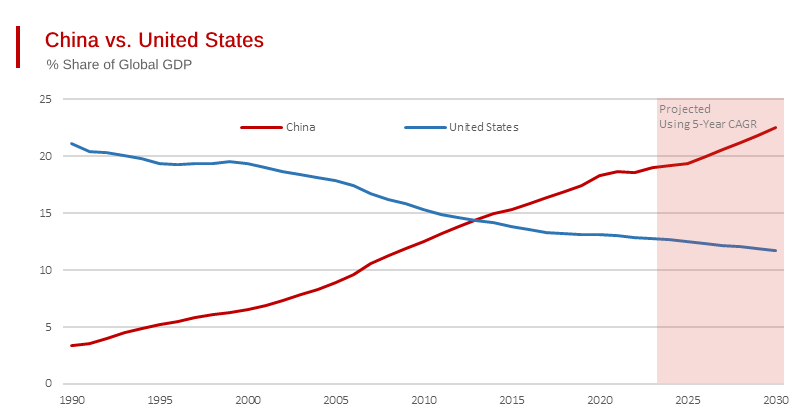
From an economic standpoint, the U.S. and China are moving in opposite directions. 

The reality is that a) there are a lot of smart, hard working, resilient, entrepreneurial people in China, b) markets have gotten much freer since Deng's reforms in 1978, c) significant capital accumulation has taken place and d) there has been tremendous investment in human capital. 

Meanwhile, the U.S. has been doing all the wrong things (it's a long list) and moving towards markets that are less free. The consequences of these trends are becoming increasingly obvious, yet instead of coming to grips with reality and working towards getting our own house in order, we Americans prefer to deny reality and blame the successful for our own failures.

Not diagnosing and fixing the problem is bad enough, but this is far worse: we risk destroying two positive countervailing forces that have helped alleviate our self-inflicted wounds. The first is turning our backs on China's productivity miracle, which has been a boon to the American consumer. The second is alienating Chinese STEM students, who bring their talents to Silicon Valley and increasingly run our most successful tech companies.

~ Kevin Duffy, Twitter/X post, October 20, 2025
Image 

Apr 22, 2025

Patrick Barron on U.S. competitiveness and need to return to the gold standard

As long as America can print fiat money to pay for imports it will print fiat money.  But under the discipline of the gold standard, Americans will have to produce good quality products at world market prices in order to earn the foreign exchange (gold) needed to settle international trade.  It’s the only way. Erecting tariffs, as desired by President Trump, solves nothing and merely exacerbates the situation.  America must learn to compete in the world on equal terms; i.e., it cannot simply print fiat dollars.  It must produce goods that foreigners wish to buy at prices that foreigners are willing to pay.  Becoming an autarkic nation, a la North Korea, will condemn Americans to poverty.  America needs to become an honest, commercially oriented nation.  If not, the world will pass it by just as has happened to other great nations in the past. 

~ Patrick Barron, "David Hume’s Insight Explains America’s Economic Decline," Going Postal, April 16, 2025


Apr 5, 2025

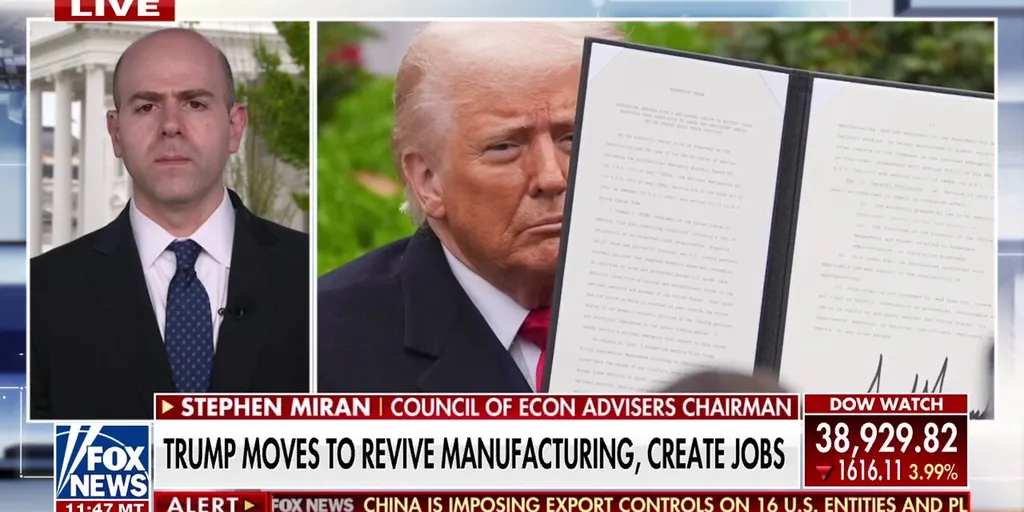
Stephen Miran: "In the long run, the tariff rate will make the United States more competitive"

The wrongs of excessive trade imbalances and the wrongs of excessive globalization didn't happen overnight and they also won't be fixed overnight...  In the long run, the tariff rate will make the United States more competitive, vis a vis our trading partners.

~ Stephen Miran, Fox News interview, April 4, 2025


Feb 26, 2025

Ruchir Sharma on competitiveness in China vs. the U.S.

The difference in China is that in some way the market is more competitive than the U.S., that if you look at the various industries there, the concentration is a lot less, the competition is a lot more intense where the U.S. big companies tend to dominate across sectors, particularly tech.  So that is the irony there, which is not that great maybe for some investors who are looking for moats.

~ Ruchir Sharma, founder, Breakout Capital, "DeepSeek has shifted the perception on China's tech prowess," CNBC, February 26, 2025


Dec 8, 2024

Jeffrey Sachs on China's success in electric vehicles

Q: One of the underlying themes or conclusions that I'm reading from the various media reports criticizing the health of the Chinese economy it that the China model, which worked for the past few decades, is not working anymore.  And the Chinese leadership, by sticking to that model, is stifling the Chinese economy.  What exactly are they trying to get at?  And what exactly is the Chinese model that they believe is not working anymore?

A: I think if I could interpret it, maybe the claim is that there's too much government intervention in the economy or China's stifling entrepreneurship.  Again, I think that this is Western rhetoric, not reality.  Let me take a very pertinent and quantitatively important example.  China is now the world's leader in electric vehicles.  During the past 10 years, there were around 400 electric vehicle companies in China.  They were competing like crazy.  Of course, there's now kind of a shaking-out process where a few companies are becoming dominant.  But the competition and the entrepreneurship has been absolutely intense.  And the result is that China is taking the leadership in worldwide sales of electric vehicles.  Also, China's domestic market now is remarkable in that more than 40 percent, I believe, of new car sales, are electric vehicles.  And when I recently visited Beijing, you see them everywhere with the green license plates and you see a tremendous change in a short period of time.

Since this is the direction that the entire world is moving towards because of the need for zero-emission vehicles, China's in a very strong position.  What is happening?  The U.S. is putting on tariffs.  Europe is putting on tariffs.  Is that a sign of failure of China?  No, quite the contrary, it's a sign of remarkable success.

~ Jeffrey Sachs, "Jeffrey Sachs on 'China collapse' theory," CGTN, December 8, 2024


Nov 18, 2024

Marc Faber on China's rise as a manufacturing superpower (2002)

I'll start with emerging markets, where valuations are attractive and expectations are very low.  Since 1990 the markets in the developed countries of Western Europe and the U.S. are up, say, five times.  In emerging economies most markets are down 80% in dollar terms, and earnings are bottoming out.  Money has been flowing out of emerging-market funds for 2-3 years. 

One concern is that Chinese competition will continue to erode the market share of other Asian exporters to Western Europe and the U.S.  In the long run, very few emerging economies will be able to compete with China.  I wouldn't rule out, in 5-10 years' time, the possibility that China becomes the workshop of the world, the way Lancashire [England] did in 1830s.  But China will also become the customer of other emerging economies.  China has a population of 1.2 billion people.  Today less than 1% of the population is outbound, but 5%-10% could be traveling over the next 10-15 years.  That would mean a meaningful influx of tourists into the surrounding countries of Asia, and Australia, New Zealand, the United States and Western Europe.  Food and plantation companies will benefit from Chinese demand.  Companies that cater to domestic consumer demand -- cigarette companies, pharmaceutical companies, software companies -- will also be helped.

~ Marc Faber, "Past and Presents Four pros speak their minds on history, science and compelling stocks," interview by Laura Rublin, Barron's, January 21, 2002

(Emphasis mine.)


Nov 17, 2024

Richard Lawrence on China's competitiveness

In the U.S., there's a certain arrogance that China's weak and has been brought to its knees and doesn't have technology and is massively overlevered and I think that's not really realistic.  If you look carefully at the semiconductor [industry], which is something I've been tracking for nearly 24 years, we can try to restrict advanced semiconductors from China, but China takes a very long view of this stuff.  And I guess in 8-10 years they're going to have similar levels of technology.  And that will have happened faster than if we had really sat down and talked about what are the uses in China for the advanced technology, the advanced chips, how to keep them out of the military.  

Well, if we ask them to keep the advanced chips out of the military, well then they're going to ask us to keep our chips out of our advanced military.  So that just hits loggerheads because our military in the U.S., there's a certain arrogance that comes with it.  So those are complicated problems that need to be resolved.

But to me I would say there are five semiconductor markets and the advanced one that goes into military equipment is really probably the smallest of all of them.  And so let's talk about the other four markets and see what we can do on that.  But there's basically no talking at this point.

~ Richard Lawrence, "Betting Big on China & Lessons from Bear Markets," We Study Billionaires, 59:30 mark, September 19, 2024


Jun 14, 2024

Jerry West on competition

I'm just ultracompetitive.  I will be till they put me in the grave. 

~ Jerry West, 1938-2024


Dec 19, 2021

Daniel McAdams on competition between the U.S. and China

Jeff Deist: Even among libertarian audiences there are people who say China is a real threat to the United States.  China is biding its time and hoping we suffer an economic fall here.  Those people at the Mises Institute who talk about secession would simply open the door for a weakened America to let the Chinese lion in.

Daniel McAdams: What would they do?  Take California?  I had lunch with my good friend Colonel Douglas McGregor and he said, our military is still fighting the idea of territorial warfare.  The rest of the world has given up on this idea.  You don't go and fight and take over.  Right now, we've taken over 30 percent of Syria.  What are we doing there?  Nobody knows.  We're the only country in the world that goes around looking to put in bases and get territory overseas.  What does it give us?  It seems to me the last thing that the Chinese would ever want would be to "own" most of the U.S.  You know, first of all, it's a basket case.  They've got their own basket case because of the economic problems they have.  Why would they want to inherit something worse?  It would be a disaster.  The real Chinese threat is that the Chinese do capitalism better than we do.  We go overseas and we overthrow governments, we take over media, we push people around, we push gay rights.  The Chinese go overseas and make business deals in foreign countries and they get the stuff they want.  They get the rare earths.  They build factories.  And that's the real reason that the Chinese will certaintly outpace us in the future.

~ Daniel McAdams, "All the Trouble in the World," The Austrian, November-December 2021


Mar 19, 2021

Jason Hsu on China, competitiveness and ESG

To outcompete globally, to generate profits - this animal spirit of responding to monetary incentives is stronger in China than any other country I ever visited. Whereas, if you look at the U.S. and Europe and Japan today: ESG investing, purpose investing, impact investing, where investors are saying, "Hey, I'm willing to make less money, lower return for other reasons," right? "My investing, my work isn't merely profit-driven." And that ethos almost points to anti-capitalism. Capitalism requires you to be entirely selfish and profit-motivated. So that's the dichotomy in China. On the one hand you have extreme profit-motivated behaviors that's led to phenomenal growth. That's led to everyone acquiring a tremendous amount of education and working tremendously hard and producing prosperity and growth, but with a backdrop of a society that's also very distrustful of a market mechanism. 

~ Jason Hsu, "Quantamental Investing Lessons with Jason Hsu," 27:30 mark, Stansberry Investor Hour, March 18, 2021


Jan 30, 2020

Abby Cohen and James Anderson on U.S. immigration controls

Image result for abby cohen and james anderson barron's roundtable

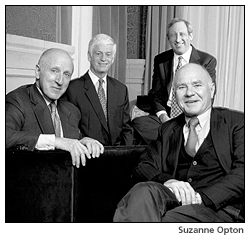
Abby Cohen: The fastest growth in job creation is at either end of the skills spectrum—high-level health care, information technology, and so on, and low-end health care and hospitality. Those broad areas are largely filled by immigrants. Over the last handful of years, the immigration rate is down. Visas for people who have special skills or visas for students are down 20% to 40% since 2015.

Image result for abby cohen and james anderson barron's roundtable

James Anderson: It is amazing to have seen America throw away its biggest comparative advantage in the way it has, particularly with regard to highly skilled, inventive people. The percentage of your great companies founded by immigrant families is staggering. It is not talked about enough.

~ Abby Cohen and James Anderson, 2020 Barron's Roundtable, January 6, 2020

Jan 26, 2020

Kobe Bryant on tenacity

If you see me in a fight with a bear, pray for the bear.

~ Kobe Bryant

Image result for kobe bryant tenacity

Jun 22, 2019

David Hale on the long-term view of Japan vs. short-termism of Corporate America

We have a tendency to emphasize short-term reward and not long-term benefits, and to view the role of a corporate sector as strictly economic and not understand that it has human dimensions.  The Japanese recognize their corporate sector to be a kind of community, which in turn commands a high level of loyalty from people.  Americans view their corporations as a place they go from 9 to 5.

~ David Hale, chief economist, Kemper Financial Services, "A Top Economist Frets About '80s Hangover," Investor's Daily, February 1, 1990

Jun 13, 2017

John Rollwagen on competitive advantage

The secret of business, especially these days, is to focus relentlessly on your unfair advantage - the thing you do that others don't.

~ John Rollwagen, former CEO, Cray Research

Feb 18, 2009

Peter Schiff on competing with Asians

It has to do with government. You know, we used to kick their asses - when we had small government, sound money, and less intervention. The reason they're beating us is because we have more government than they do. We have a bigger obstacle to overcome.

~ Peter Schiff, Interview on The Glenn Beck Show, September 29, 2008

Jun 8, 2008

BW: Book critical of Japan's electronics industry "jumping off shelves" (2007)

Fumiaki Sato's latest book sounds like a bit of a snooze: It's titled A Scenario for the Realignment of Japan's Electronics Industry. But the Deutsche Bank analyst's 323-page tome has been jumping off shelves since its release last August. It's now in its fourth printing as electronics companies buy it for their employees, and Sony Corp. has even asked for an English version. Sato's message is dire. "Japan's electronics makers aren't competitive enough to survive for long," he says.

~ BW, "Do or Die; A book calling for the remaking of Japan's electronics industry is a surprise hot seller," May 7, 2007, by Kenji Hall

Image result for kenji hall