Showing posts with label voting. Show all posts

Apr 29, 2026

Hans-Hermann Hoppe on democracy

What is true, just and beautiful is not determined by popular vote.  The masses everywhere are ignorant, short-sighted, motivated by envy, and easy to fool.  Democratic politicians must appeal to these masses in order to be elected.  Whoever is the best demagogue will win.  Almost by necessity, then, democracy will lead to the perversion of truth, justice and beauty.

~ Hans-Hermann Hoppe, Democracy: The God That Failed, 2001 

Hans-Hermann Hoppe - Wikiquote 

Kevin Duffy and Jeremy Hammond on participatory democracy, i.e. voting

Duffy: A key pillar of the statist belief system is participatory democracy.  Everyone gets a say (or vote), no matter how ignorant they are of the inner workings of the system.  This way critics like us are more easily dismissed.  Normally, 10,000 hours of study would qualify us as "experts," but not in this case.  There are no valued experts on the system itself.  It's simply assumed to be the greatest system of societal organization ever conceived by mankind.  To suggest otherwise is to be dismissed as a heretic. 

Hammond: Ah, yes, a huge part of the problem is the compulsion to vote—or as I prefer to describe it, to act to legitimize the criminal organization in Washington. I don't want to bicker over which head of the beast should devour us; I want to slay the beast.

~ Kevin Duffy and Jeremy Hammond, email exchange, April 29, 2026

Politics of Monarchy,... 9780765800886 ... 

Jun 14, 2025

Murray Rothbard on consumers, voters and knowledge

Consumers also take entrepreneurial risks on the market.  Many critics of the market, while willing to concede the expertise of the capitalist-entrepreneurs, bewail the prevailing ignorance of consumers, which prevents them from gaining the utility ex post that they had expected ex ante.  Typically, Wesley C. Mitchell entitled one of his famous essays: ‘The Backward Art of Spending Money.’  Professor Mises has keenly pointed out the paradox of interventionists who insist that consumers are too ignorant or incompetent to buy products intelligently, while at the same time proclaiming the virtues of democracy, where the same people vote for or against politicians whom they do not know and on policies which they scarcely understand.  

To put it another way, the partisans of intervention assume that individuals are not competent to run their own affairs or to hire experts to advise them, but they also assume that these same individuals are competent to vote for these experts at the ballot box.  They are further assuming that the mass of supposedly incompetent consumers are competent to choose not only those who will rule over themselves, but also over the competent individuals in society.  Yet such absurd and contradictory assumptions lie at the root of every program for ‘democratic’ intervention in the affairs of the people. 

In fact, the truth is precisely the reverse of this popular ideology.  Consumers are surely not omniscient, but they have direct tests by which to acquire and check their knowledge.  They buy a certain brand of breakfast food and they do not like it; and so they do not buy it again.  They buy a certain type of automobile and like its performance; they buy another one.  And in both cases, they tell their friends of this newly won knowledge.  Other consumers patronize consumers’ research organizations, which can warn or advise them in advance.  But, in all cases, the consumers have the direct test of results to guide them.  And the firm which satisfied the consumers expands and prospers and thus gains ‘good will,’ while the firm failing to satisfy them goes out of business.  

On the other hand, voting for politicians and public policies is a completely different matter.  Here there are no direct tests of success or failure whatever, neither profits and losses nor enjoyable or unsatisfying consumption.  In order to grasp consequences, especially the indirect catallactic consequences of governmental decisions, it is necessary to comprehend complex chains of praxeological reasoning.  Very few voters have the ability or the interest to follow such reasoning, particularly, as Schumpeter points out, in political situations.  For the minute influence that any one person has on the results, as well as the seeming remoteness of the actions, keeps people from gaining interest in political problems or arguments.  Lacking the direct test of success or failure, the voter tends to turn, not to those politicians whose policies have the best chance of success, but to those who can best sell their propaganda ability.  Without grasping logical chains of deduction, the average voter will never be able to discover the errors that his ruler makes.  

George J. Schuller, in attempting to refute this argument, protested that: ‘complex chains of reasoning are required for consumers to select intelligently an automobile or television set.’  But such knowledge is not necessary; for the whole point is that the consumers have always at hand a simple and pragmatic test of success: does the product work and work well?  In public economic affairs, there is no such test, for no one can know whether a particular policy has ‘worked’ or not without knowing the a priori reasoning of economics.

~ Murray Rothbard, Man, Economy, and State (1962)

(As quoted by Lew Rockwell in "The Greatness of Man, Economy, and State," LewRockwell.com, June 4, 2025.  See also here under "E. Utility Ex Post.")


May 12, 2021

Thomas Sowell on voting

If you are not informed, then the most patriotic thing you can do on election day is stay home.

~ Thomas Sowell


Nov 7, 2020

Napoleon on voting

I care not who casts the votes of a nation, provided I can count them.

~ Napoleon, New York Times editorial, May 26, 1880


Jun 13, 2020

Thomas Sowell on racism, fear and votes

Racism is not dead. But it is on life-support, kept alive mainly by the people who use it for an excuse or to keep minority communities fearful or resentful enough to turn out as a voting bloc on election day.

~ Thomas Sowell

A Salute To Thomas Sowell

Jan 20, 2020

Charles Bukowski on the difference between democracy and dictatorship

The difference between a democracy and a dictatorship is that in a democracy you vote first and take orders later; in a dictatorship you don't have to waste your time voting.

~ Charles Bukowski

Register & Vote
1968

Jul 13, 2019

Mark Twain on voting

If voting made any difference they wouldn't let us do it.

~ Mark Twain

Image result for mark twain


Jul 12, 2019

Robert Higgs on the irrationality of pursuing ends through political means

To elicit the desired response from government, people take costly actions.  They sacrifice valuable time, effort, money, and other resources in order to send letters and telegrams to politicians, campaign and vote for candidates and pressure groups, and act in other ways as members of large political groups.  Although such actions are utterly familiar, the first theorist to inquire seriously whether they are rational concluded that, except under special conditions, they are not.

~ Robert Higgs, Crisis and Leviathan, p. 39

Image result for robert higgs crisis and leviathan

Oct 22, 2018

Benjamin Franklin on democracy and liberty

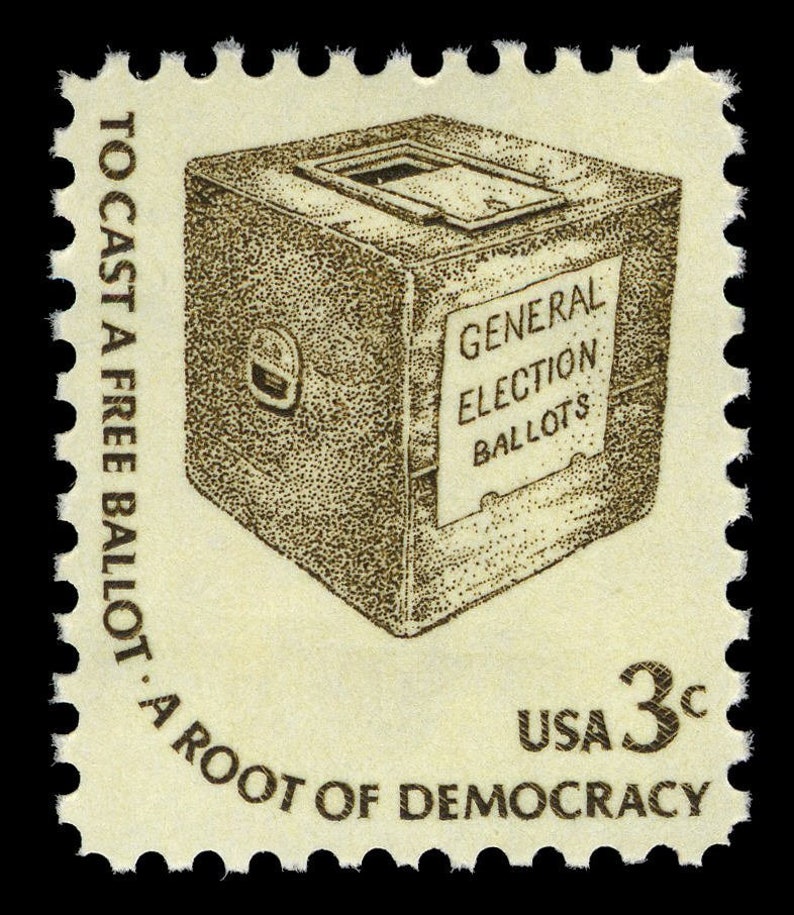
Democracy is two wolves and a lamb voting on what to have for lunch.  Liberty is a well-armed lamb contesting the vote.

~ Benjamin Franklin

Vintage Three Cent Postage Stamp 1977 Americana Series image 0

Nov 5, 2008

Emma Goldman on the right to vote

If voting changed anything, they'd make it illegal.

~ Emma Goldman

Image result for protection racket cartoon

Jul 3, 2008

Bernard Baruch on voting

Vote for the man who promises least; he'll be the least disappointing.

~ Bernard Baruch

Image result for bernard baruch

Feb 19, 2008

Kevin Duffy on reforming the voting process

We should divide the country into those who support the state (net tax payers) and those who live off of the state (net tax eaters). The latter group would automatically include politicians, bureaucrats, lobbyists, lawyers, public school teachers, etc. and should be denied the vote. Somehow, I would imagine the presidential debates would be quite different.

~ Kevin Duffy, Bearing Asset Management, February 18, 2008

Register and Vote
1964

Jan 5, 2008

Phil Duffy on political campaigns

Campaigning is essentially the irrelevant seeking votes from the irresponsible.

~ Phil Duffy

Image result for blind leading the blind

Oct 21, 2007

Mencken on democracy

An election is nothing more than the advanced auction of stolen goods.

~ H.L. Mencken, author

Image result for voting booth"