~ Eric Johnston, Cantor Fitzgerald, CNBC interview with Scott Wapner, 2:20 mark, January 18, 2023
Showing posts with label unemployment. Show all posts
Jan 18, 2023
Eric Johnston on using the unemployment rate as a contrary indicator
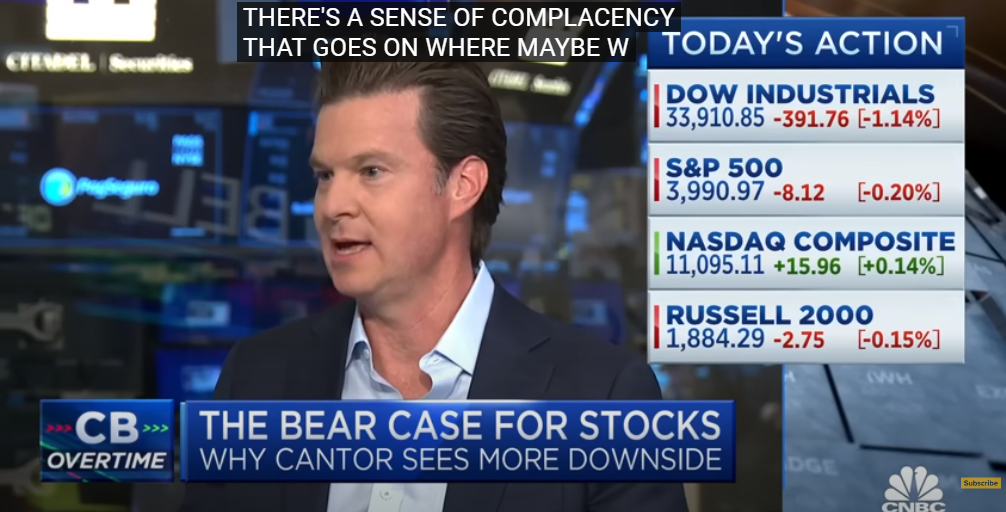
If you look at the past selloffs in the market, they've all started with a very low unemployment rate. So February of 2020? That was a 50-year low unemployment rate. 2007? That was a 6-year low unemployment rate. In the bubble of 2000, everything felt great in February of 2000. We were at a 30-year low unemployment rate. Things felt great and then... things completely fell apart. So in the beginning of these things, there's a sense of complacency that goes where "maybe we can get through this." But the reality is, is that it always feels this way in the beginning. We go in cycles and I think over time, if you sold a 3 1/2% to 4 1/2% unemployment rate and you bought a 10% unemployment rate, you would do very well. And right now we are towards the end of the cycle, and whether the cycle ends in 2023 or '24, it's probably on its last legs.
Jun 28, 2021
Peter Atwater on expanded unemployment benefits
We've gone from maternity leave to paternity leave to eternity leave as employees are simply choosing not to come back to work at all.
~ Peter Atwater, tweet, June 28, 2021
May 10, 2021
Sam Zell on welfare incentives not to work
We've created a welfare society that is really discouraging people [from working]. When you can make as much or more by collecting unemployment insurance, and supplemental this and supplemental that, that's pretty dangerous stuff. Clearly, we're having trouble getting everybody back into the workforce because the alternative is so attractive.
~ Sam Zell, "Sam Zell Buys Gold With Inflation ‘Reminiscent of the ‘70s’," Bloomberg interview, 2:25 mark, May 4, 2021
Labels:
employment,
people - Zell; Sam,
unemployment,
welfare,
welfare state
Oct 31, 2020
Brad Polumbo on generous unemployment benefits to counter Covid lockdowns
Trapping more people in a state of government dependency isn’t generous—and it isn’t sustainable. It’s cruel.
~ Brad Polumbo, "Why Responding to the COVID Poverty Spike With More Welfare is Cruel, Not Generous," FEE.org, October 27, 2020
Jun 3, 2020
Ludwig von Mises on mass unemployment providing recruiting ground for radical political movements
Permanent mass unemployment destroys the moral foundations of the social order. The young people, who, having finished their training for work, are forced to remain idle, are the ferment out of which the most radical political movements are formed. In their ranks the soldiers of the next revolution are recruited.
~ Ludwig von Mises, Socialism
Feb 19, 2020
Kevin Duffy on full employment and low wage growth
Q: Why do we have full employment, but very low wage growth?
A: No one can honestly answer this because the economy is too complex. Beware those who try to explain this with soundbites (like politicians). They're either liars or lying to themselves.
Economic principles are a different matter. These don't change. Beware economic explanations (and prescriptions) that fly in the face of economic principles.
Just because we can't know everything about an economy, doesn't mean we shouldn't try to learn what we can and speculate about different causes. Ok, the official unemployment rate is low. Why? Is this a good indication of the overall happiness that people have with their jobs? If so, why is Bernie Sanders so popular? I suspect there is a large segment of the population that is not happy with their economic situation.
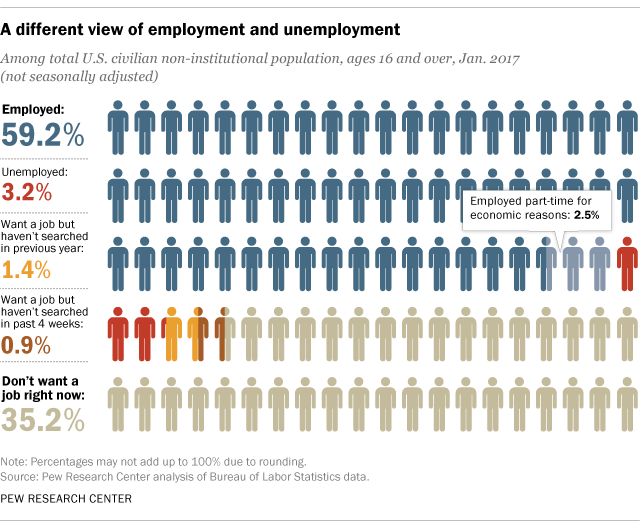
Statistics often give a false sense of knowledge. The so-called labor participation rate is low, which means many people are simply not counted. Should they be? Are these people happily retired at an early age, living on welfare, living in a friend's basement, or earning a lucrative living in the black market?
On the other side, there are clearly a lot of employers who aren't happy. They have positions to fill, but can't find skilled workers. Tighter immigration policies that impact high-skilled workers may be exacerbating this situation. Our socialized education system is not helping.
Then there's this nasty thing call the boom-bust cycle. It happens when the central bank artificially lowers rates, causing asset bubbles and an unsustainable boom. Sound familiar? The official unemployment rates is ALWAYS low when this happens. That of course reverses with the bust.
It's complicated...
~ Kevin Duffy, answer to Facebook question, February 19, 2020
A: No one can honestly answer this because the economy is too complex. Beware those who try to explain this with soundbites (like politicians). They're either liars or lying to themselves.
Economic principles are a different matter. These don't change. Beware economic explanations (and prescriptions) that fly in the face of economic principles.
Just because we can't know everything about an economy, doesn't mean we shouldn't try to learn what we can and speculate about different causes. Ok, the official unemployment rate is low. Why? Is this a good indication of the overall happiness that people have with their jobs? If so, why is Bernie Sanders so popular? I suspect there is a large segment of the population that is not happy with their economic situation.
Statistics often give a false sense of knowledge. The so-called labor participation rate is low, which means many people are simply not counted. Should they be? Are these people happily retired at an early age, living on welfare, living in a friend's basement, or earning a lucrative living in the black market?
On the other side, there are clearly a lot of employers who aren't happy. They have positions to fill, but can't find skilled workers. Tighter immigration policies that impact high-skilled workers may be exacerbating this situation. Our socialized education system is not helping.
Then there's this nasty thing call the boom-bust cycle. It happens when the central bank artificially lowers rates, causing asset bubbles and an unsustainable boom. Sound familiar? The official unemployment rates is ALWAYS low when this happens. That of course reverses with the bust.
It's complicated...
~ Kevin Duffy, answer to Facebook question, February 19, 2020
Aug 15, 2011
Obama says Congress causes unemployment
There is no shortage of ideas to put people to work right now. What is needed is action on the part of Congress.
~Barack Obama, president, United States of America, speech given at Cannon Falls, Minnesota, August 15, 2011
Mar 23, 2011
Warren Buffett worries about inflation but cites 'idle capacity' bulwark
I don't know much about India, but I do know things that lead to inflation over time. And Chairman Bernanke knows a lot better than I do, I'm not claiming superior knowledge on this in any way, but we are doing things which are inflationary and to some extent the Fed has acknowledged that it wants that. It wasn't so long ago that it said it wanted this 2% per year rule for inflation. And that's really something different than it was historically, to actually peg a rate of inflation as being the goal and I think it's going to be very hard to fine-tune that number.
Once you get inflationary expectations starting to build in, and I think they are building in, once you get that ball rolling it's a hard thing to stop. Now, like I say, the Fed is very conscious of that, but being conscious of it doesn't necessarily mean you control it once it gets going.
We have this idle capacity in the United States, we have lots of unemployment so that would argue against inflation catching hold, but just take a look at what's taking place in food and fuel and metals and everything else and it could lead to inflation.
~Warren Buffett, the Oracle of Omaha, CNBC interview, March 23, 2011
Once you get inflationary expectations starting to build in, and I think they are building in, once you get that ball rolling it's a hard thing to stop. Now, like I say, the Fed is very conscious of that, but being conscious of it doesn't necessarily mean you control it once it gets going.
We have this idle capacity in the United States, we have lots of unemployment so that would argue against inflation catching hold, but just take a look at what's taking place in food and fuel and metals and everything else and it could lead to inflation.
~Warren Buffett, the Oracle of Omaha, CNBC interview, March 23, 2011
May 3, 2010
Warren Buffett on jobs
We have jobs when we have demand for our goods, we're not going to hire somebody just to stand around. The best jobs program is demand. Demand is coming back, and that means we hire people.
~Warren Buffett, Goldman Sachs investor, "The Buffett Express", CNBC's Squawk Box, May 3rd, 2010
Jan 10, 2008
Lionel Robbins on how inflexible wage rates created unemployment during the Great Depression
If it had not been for the prevalence of the view that wage rates must at all costs be maintained in order to maintain the purchasing power of the consumer, the violence of the present depression and the magnitude of the unemployment which has accompanied it would have been considerably less…. A policy which holds wage rates rigid when the equilibrium rate has altered, is a policy which creates unemployment.
~ Lionel Robbins, The Great Depression (1934)
Subscribe to:
Posts (Atom)