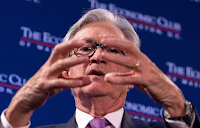
~ Mohamed El-Erian, President at Queens' College, LinkedIn post, August 2, 2023
Showing posts with label people - El-Erian; Mohamed. Show all posts
Aug 2, 2023
Mohamed El-Erian on the U.S. government debt downgrade by Fitch
Overall, this announcement is much more likely to be dismissed than have a lasting disruptive impact on the U.S. economy and markets.
May 3, 2023
Mohamed El-Erian on JPMorgan's takeover of failed First Republic Bank
Look at what JPMorgan acquired. First Republic was one of the most envied banks. Why? It had very rich depositors, it was able to make jumbo mortgages to very creditworthy clients and it had what was viewed as the best client experience, the best customer service. All that is now acquired by JPMorgan at a cost that's only moderately more than what they would have lost [$5 billion] in their deposits that they put in First Republic. So for JPMorgan, that is a great deal. And you see that in the stock price. Now will it make a huge difference to the bank? No. But at the margin it is undoubtedly and unambiguously beneficial to JPMorgan.
~ Mohamed El-Erian, interview on CNBC, May 1, 2023
Mar 31, 2023
Tom Ozimek on credit tightening at small banks
Small banks lost $120 billion in deposits in the week that ended on March 15, a record drop. Allianz chief economic adviser and noted economist Mohamed El-Erian wrote in a recent op-ed in Bloomberg that if deposit outflow from regional banks continues, this spells trouble.
“This could become a big issue for local communities, regions, and sectors that fear that their access to loans will be curtailed because their traditional banking partners will have to shrink their balance sheets after losing deposits,” he wrote.
El-Erian believes that the bank turmoil will slowly infect the real economy by squeezing access to credit.
~ Tom Ozimek, "Bank Turmoil Could Spread to Real Economy, Squeezing Credit Supply, Experts Warn," The Epoch Times, March 30, 2023
Mar 16, 2023
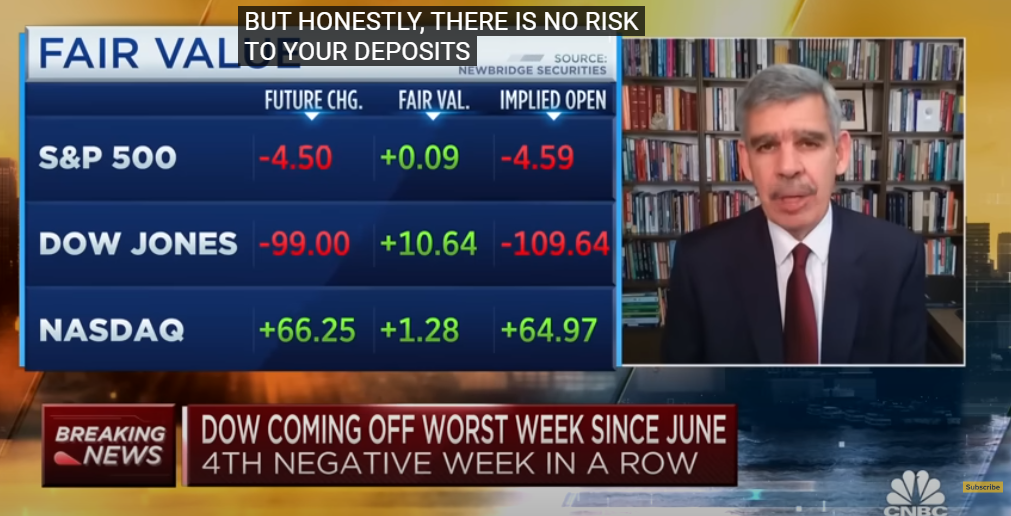
Mohamed El-Erian on BTFP guaranteeing uinsured deposits
We're here [bank failures] basically because we had a prolonged period of overly-loose monetary policy. When it came to adjusting monetary policy, the Fed did not act fast enough and then it had to hit on the breaks. And you've heard me say over and over again, when you hit the breaks, you risk both economic and financial accidents. And we've just lived through a financial accident.
It's important to stress that depositors should not worry. Your deposits are fine. And there is no need to move your deposits... Honestly, there is no risk to your deposits anymore.
It is almost impossible now to go back on unlimited deposit guarantee.
~ Mohamed El-Erian, CNBC interview, 0:45 mark, March 13, 2023
Mar 12, 2013
Mohamed El-Erian compares the Fed to the Wizard of Oz
When you think of it, in today's economy, the role of the wizard is being played by the Federal Reserve Bank. Facing a difficult economic situation, made worse by the inaction of a bickering Congress and essentially paralyzed government agencies, the Fed has found itself forced to take on the role of savior. And since its massive emergency interventions in 2008, it has felt a moral obligation to stay engaged, a role which, over time, it seems to have pursued more willingly.
In trying to do good, the Fed has confronted more than the considerable dark forces of disorderly economic and financial deleveraging. It has also had to overcome the (not-so-occasional) headwinds from a disruptive Congress and a Europe unable to decisively overcome a regional debt crisis.
~ Mohamed A. El-Erian, "The Fed as ‘Oz, the Great and Powerful’," Yahoo!Finance, March 12, 2013
In trying to do good, the Fed has confronted more than the considerable dark forces of disorderly economic and financial deleveraging. It has also had to overcome the (not-so-occasional) headwinds from a disruptive Congress and a Europe unable to decisively overcome a regional debt crisis.
~ Mohamed A. El-Erian, "The Fed as ‘Oz, the Great and Powerful’," Yahoo!Finance, March 12, 2013
May 17, 2011
PIMCO's El-Arian on the arrest of IMF chief Strauss-Kahn
Don’t underestimate how important Dominique Strauss-Kahn was in coordinating action [among European nations]. It’s the worst possible time to lose your general. You need the IMF to coordinate this global healing.
He has been getting everybody to play from the same sheet of music. Without him it will be much more difficult to coordinate European governments.
~Mohamed El-Arian, chief executive officer, PIMCO, Bloomberg's "In The Loop", May 17, 2011
(El-Arian is also a former deputy managing director of the IMF)
He has been getting everybody to play from the same sheet of music. Without him it will be much more difficult to coordinate European governments.
~Mohamed El-Arian, chief executive officer, PIMCO, Bloomberg's "In The Loop", May 17, 2011
(El-Arian is also a former deputy managing director of the IMF)
Mar 31, 2011
Mohamed El-Arian begs to be taxed more, argues income inequality is bad
Bill [Gross] and I – we do not consider ourselves elite. In fact, we’d like to be taxed more. I said this even before the Middle East started: It is not in the interest of any society for income inequality to keep on going up. It is in everybody’s interest to avoid the extremes.
~Mohamed El-Arian, CEO, PIMCO, Bloomberg Television interview, March 31, 2011
Oct 29, 2009
Mohamed El-Erian, Pimco on the recapitalization of the financial sector
Q: So what is anchoring the markets today?
A: We're seeing a much-needed recapitalization. Over the past decade you've seen the balance sheet of the emerging markets get recapitalized. Then it was the turn of the U.S. corporate and industrial sector on the back of Enron and WorldCom. Today we're seeing the recapitalization of the U.S. financial system. A massive amount of capital has been issued in the past two weeks, some in the form of preferred stock. Once we get through [this period], we'll all look back and realize that it's positive.
Q: Is the worst behind us?
A: We're three-quarters through a major dislocation that has repriced the U.S. financial system. The risk going forward is less about Wall Street and more about the small and midsize banks. They missed much of the current crisis because they never really got into structured products. But they're heavily tied to commercial real estate and the consumer.
~ Mohamed El-Erian, Pimco, "A Peek at Pimco's Long View," BusinessWeek, May 19, 2008
A: We're seeing a much-needed recapitalization. Over the past decade you've seen the balance sheet of the emerging markets get recapitalized. Then it was the turn of the U.S. corporate and industrial sector on the back of Enron and WorldCom. Today we're seeing the recapitalization of the U.S. financial system. A massive amount of capital has been issued in the past two weeks, some in the form of preferred stock. Once we get through [this period], we'll all look back and realize that it's positive.
Q: Is the worst behind us?
A: We're three-quarters through a major dislocation that has repriced the U.S. financial system. The risk going forward is less about Wall Street and more about the small and midsize banks. They missed much of the current crisis because they never really got into structured products. But they're heavily tied to commercial real estate and the consumer.
~ Mohamed El-Erian, Pimco, "A Peek at Pimco's Long View," BusinessWeek, May 19, 2008
Subscribe to:
Posts (Atom)