Showing posts with label blowback. Show all posts

Dec 27, 2023

Brahma Chellaney on how Israel's policy of backing Hamas was influenced by U.S. support for mujahideen in Afghanistan

The international focus on the war in Gaza has helped obscure the fact that Israel in the 1980s aided the rise of the Islamist Hamas as a rival to the secular Palestinian Liberation Organization and its dominant faction, Yasser Arafat’s Fatah.  Israel’s policy was clearly influenced by the U.S. training and arming of mujahideen (or Islamic holy warriors) in Pakistan from multiple countries to wage jihad against Soviet forces in Afghanistan. 

The multibillion-dollar American program from 1980 to create anti-Soviet jihadis represented what still remains the largest covert operation in the Central Intelligence Agency’s history.  In 1985, at a White House ceremony attended by several mujahideen, then-U.S. President Ronald Reagan gestured toward his guests and declared, “These gentlemen are the moral equivalent of America’s Founding Fathers.”

Out of the mujahideen evolved the Taliban and al-Qaida.  As then-U.S. Secretary of State Hillary Clinton openly admitted in 2010, “We trained them, we equipped them, we funded them, including somebody named Osama bin Laden ... And it didn’t work out so well for us.”

~ Brahma Chellaney, "Israel's Historical Role in the Rise of Hamas," The Japan Times, November 21, 2023

President Reagan meeting with Afghan mujahideen
leaders in the Oval Office in 1983


Mehdi Hasan on how Israel helped finance Hamas

[D]id you also know that Hamas — which is an Arabic acronym for “Islamic Resistance Movement” — would probably not exist today were it not for the Jewish state?  That the Israelis helped turn a bunch of fringe Palestinian Islamists in the late 1970s into one of the world’s most notorious militant groups?  That Hamas is blowback?

This isn’t a conspiracy theory.  Listen to former Israeli officials such as Brig. Gen. Yitzhak Segev, who was the Israeli military governor in Gaza in the early 1980s.  Segev later told a New York Times reporter that he had helped finance the Palestinian Islamist movement as a “counterweight” to the secularists and leftists of the Palestine Liberation Organization and the Fatah party, led by Yasser Arafat (who himself referred to Hamas as “a creature of Israel.”)

“The Israeli government gave me a budget,” the retired brigadier general confessed, “and the military government gives to the mosques.”

~ Mehdi Hasan, "Blowback: How Israel Went From Helping Create Hamas to Bombing It," The Intercept, February 19, 2018


Dec 4, 2023

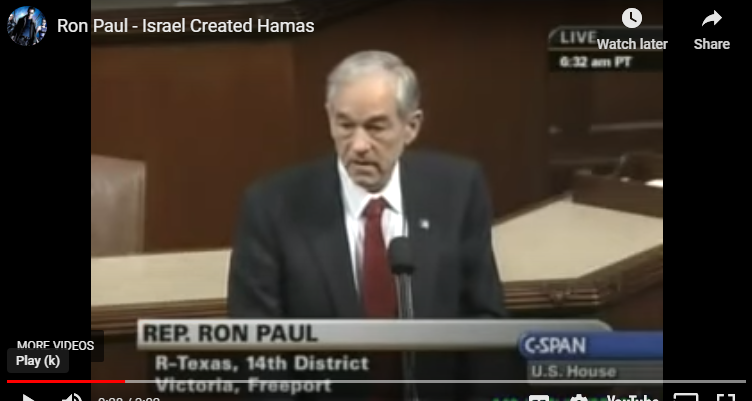
Ron Paul on Hamas and blowback (2009)

[Paul’s 2009 comments came as he rose in opposition to House Resolution 34, “Recognizing Israel’s right to defend itself against attacks from Gaza, reaffirming the United States’ strong support for Israel, and supporting the Israeli-Palestinian peace process.”]

I rise in opposition to this resolution, not because I am taking sides and picking who the bad guys are and who the good guys are, but I'm looking at this more from the angle of being a United States citizen, an American.  And I think resolutions like this really do us great harm.

In many ways, what’s happening in the Middle East, in particular with Gaza right now, we have some moral responsibility for both sides in a way because we provide help and funding for both Arab nations and Israel.  We have a moral responsibility, especially now today the weapons being used to kill so many Palestinians are American weapons and American funds are being used for this.

But there’s a political liability, which I think is something we fail to look at because too often there’s so much blowback from our intervention in areas that we shouldn’t be involved in.

You know Hamas, if you look at the history, you’ll find out that Hamas was encouraged and really started by Israel because they wanted Hamas to counteract Yasser Arafat.

You say, "Well, yeah, it was better then and served its purpose, but we didn’t want Hamas to do this." So then we, as Americans, say, "Well, we have such a good system; we’re going to impose this on the world.  We’re going to invade Iraq and teach people how to be democrats.  We want free elections."  So we encouraged the Palestinians to have a free election. They do, and they elect Hamas.

So we first, indirectly and directly through Israel, helped establish Hamas.  Then we have an election where Hamas becomes dominant, then we have to kill them.  It just doesn’t make sense.  During the 80s, we were allied with Osama bin Laden and we were contending with the Soviets.  It was at that time our CIA thought it was good if we radicalize the Muslim world.  So we finance the Madrassas school to radicalize the Muslims in order to compete with the Soviets.  There is too much blowback.

There are a lot of reasons why we should oppose this resolution.  It’s not in the interest of the United States, it is not in the interest of Israel either.

~ Rep. Ron Paul (R-TX), speech on House floor, 2009


Oct 10, 2022

Tom Woods on sanctions on Iraq and inevitable reprisals "in the form of terrorist attacks" (2001)

In general, a policy of sanctions hurts only the civilian population, leaving the government more or less untouched.

If anything, sanctions may even tend to strengthen popular support for the government inasmuch as the leader can now portray himself and his nation as the besieged victims of a vindictive U.S.

Especially disconcerting about the Clinton-Albright policy [of sanctions on Iraq] was its blithe disregard of any long-term consequences for the U.S. essentially starving a helpless country to death.

Set aside the morality of the question for a moment, as Clinton and Albright did, and think only of U.S. interests.  The Gulf War has been over for 10 years, and American students still can't distinguish Baghdad from Wagga Wagga on a map.  But do you suppose the Iraqi people have forgotten, or ever will?

If the U.S. continues on its present course, it is next to impossible to imagine that we can forever avoid the terrible reprisals, in the form of terrorist attacks - nuclear, chemical or otherwise - that our policy makes almost inevitable.

~ Thomas E. Woods, Jr., "Lift U.S. Sanctions: They Choke The Tyrannized More Than The Tyrants," Investor's Business Daily, March 19, 2001