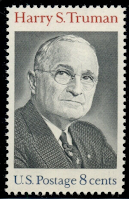
Showing posts with label people - Truman; Harry. Show all posts

Oct 6, 2026

U.S. presidents on war and sacrifice

Civil War:

It is rather for us to be here dedicated to the great task remaining before us ― that from these honored dead we take increased devotion to that cause for which they gave the last full measure of devotion ― that we here highly resolve that these dead shall not have died in vain.

~ President Abraham Lincoln, Gettysburg Address, November 19, 1863

World War I: 

There are, it may be, many months of fiery trial and sacrifice ahead of us...  To such a task we can dedicate our lives and our fortunes, everything that we are and everything that we have, with the pride of those who know that the day has come when America is privileged to spend her blood and her might for the principles that gave her birth and happiness and the peace which she has treasured.

~ President Woodrow Wilson, war message to Congress, April 2, 1917

World War II:

“It is not a sacrifice for any man, old or young, to be in the Army or Navy of the United States.  Rather it is a privilege.  It is not a sacrifice for the industrialist or the wage-earner, the farmer or the shopkeeper, the trainman or the doctor, to pay more taxes, to buy more bonds, to forego extra profits, to work longer or harder at the task for which he is best fitted.  Rather it is a privilege.  It is not a sacrifice to do without many things to which we are accustomed if the national defense calls for doing without.” 

~ President Franklin D. Roosevelt, radio address after Pearl Harbor, December 9, 1941

This Day in History: FDR's D-Day Prayer 

Korean War:

To do this will require hard work and sacrifice by all of us. I know all of us are prepared to do whatever is necessary in the cause of peace and freedom.

~ President Harry Truman, radio and television report, September 1, 1950

Cold War:

Let every nation know, whether it wishes us well or ill, that we shall pay any price, bear any burden, meet any hardship, support any friend, oppose any foe to assure the survival and the success of liberty.

~ President John F. Kennedy, inaugural address, January 20, 1961

War on Terror:

Two years ago, I told the Congress and the country that the war on terror would be a lengthy war, a different kind of war fought on many fronts in many places. Iraq is now the central front… This will take time and require sacrifice. Yet we will do what is necessary, we will spend what is necessary to achieve this essential victory in the war on terror, to promote freedom and to make our own nation more secure.

~ President George W. Bush, address to the nation, September 7, 2003

Amid all this violence, I know Americans ask the question: Is the sacrifice worth it?  It is worth it, and it is vital to the future security of our country.

~ President George W. Bush, June 28, 2005, speech at Fort Bragg

President Bush Thanks Military on Independence Day at Fort Bragg, North Carolina 

Iran War:

As we celebrate this progress, we think especially of the 13 American warriors who have laid down their lives in this fight to prevent our children from ever having to face a nuclear Iran… And now we must honor them by completing the mission for which they gave their lives.

~ President Donald Trump, address to the nation, April 1, 202

Dec 29, 2023

Neil Rogall on Truman supported Jewish immigration to Palestine after WWII

By 1945 the US government fully supported the Zionists.  They knew how important oil had been in war and were keen to have reliable allies in the Middle East.  The news of the death camps in Germany led to worldwide sympathy for the Jews.  The Zionists used this to bolster their demands.  President Roosevelt’s successor Harry Truman put pressure on the British to allow all Jewish holocaust survivors to be sent to Palestine.  The British refused.  This wasn’t sympathy on Truman’s part.  Most camp survivors wanted to go to the USA. But Truman was an openly racist and anti-Semitic politician who had only been chosen as Roosevelt’s running mate to placate southern 'Dixiecrats.'  Truman was opposed to letting Jewish refugees into the US. However, in 1947, the Zionists won a key propaganda battle.  The Exodus, a packed refugee ship was sent back from Palestine to Germany.  Much western opinion saw this as an inhuman act.

~ Neil Rogall, "Making the Palestinians the scapegoats for Nazi crimes," rs21, October 9, 2014

Harry Truman with Israeli President Chaim Weizmann


Dec 12, 2023

Sheldon Richman on the UN partition plan for Israel

By mid-November 1947 the Truman administration was firmly in the Zionist camp.  When the State Department and the U.S. mission to the United Nations agreed that the partition resolution should be changed to shift the Negev from the Jewish to the Palestinian state, Truman sided with the Jewish Agency, the main Zionist organization, against them.  The United States also voted against a UN resolution calling on member states to accept Jewish refugees who could not be repatriated.

As the partition plan headed toward a vote in the UN General Assembly, U.S. officials applied pressure to--and even threatened to withhold promised aid from--countries inclined to vote against the resolution.  As former under-secretary of state Sumner Welles put it: 
By direct order of the White House every form of pressure, direct and indirect, was brought to bear by American officials upon those countries outside of the Moslem world that were known to be either uncertain or opposed to partition. Representatives or intermediaries were employed by the White House to make sure that the necessary majority would at length be secured.
Eddie Jacobson recorded in his diary that Truman told him that "he [Truman] and he alone, was responsible for swinging the vote of several delegations."

While the plan was being debated, the Arabs desperately tried to find an alternative solution.  Syria proposed that the matter be turned over to the International Court of Justice in The Hague; the proposal was defeated.  The Arab League asked that all countries accept Jewish refugees "in proportion to their area and economic resources and other relevant factors"; the league's request was denied in a 16-16 tie, with 25 abstentions.

On November 29 the General Assembly recommended the partition plan by a vote of 33 to 13.  The Soviet Union voted in favor of the resolution, reversing its earlier position on Zionism; many interpreted the vote as a move to perpetuate unrest and give Moscow opportunities for influence in the neighboring region. 

The period after the UN partition vote was critical.  The Zionists accepted the partition reluctantly, hoping to someday expand the Jewish state to the whole of Palestine, but the Arabs did not.  Violence between Jews and Arabs escalated.  The obvious difficulties in carrying out the partition created second thoughts among U.S. policymakers as early as December 1947.  The State Department's policy planning staff issued a paper in January 1948 suggesting that the United States propose that the entire matter be returned to the General Assembly for more study.  Secretary Forrestal argued that the United States might have to enforce the partition with troops.  (The United States had an arms embargo on the region at the time, although arms were being sent illegally by American Zionists, giving the Jews in Palestine military superiority, at least in some respects, over the Arabs.)

On February 24, 1948, the U.S. ambassador to the United Nations, Warren Austin, made a speech to the Security Council hinting at such second thoughts.  His proposal to have the five permanent council members discuss what should be done was approved, but they could not agree on a new strategy.  The United States, China, and France reported to the full council that partition would not occur peacefully.  The apparent weakening of U.S. support for partition prompted the Zionist organizations to place enormous pressure on Truman, who said he still favored partition.  However, the next day at the United Nations, Austin called for a special session of the General Assembly to consider a temporary UN trusteeship for Palestine. 

On April 16 the United States formally proposed the temporary trusteeship.  The Arabs accepted it conditionally; the Jews rejected it.  The General Assembly was unenthusiastic.  Meanwhile, the Zionists proceeded with their plans to set up a state.  Civil order in Palestine had almost totally broken down.  For example, in mid-April, the Irgun and LEHI (the Stern Gang), two Zionist terrorist organizations, attacked the poorly armed Arab village of Deir Yassin, near Jerusalem, and killed 250 men, women, and children.  The Arabs retaliated by killing many Jews the next day.

Before the British left in May, the Jews had occupied much additional land, including cities that were to be in the Palestinian state. 

Something else was working in favor of continued support for the emerging Jewish state: U.S. domestic politics.  The year 1948 was an election year and, according to memoranda in the Harry S Truman Library and Museum, Jacobson, Clifford, and Niles expressed fear that the Republicans were making an issue of their support for the Jewish state and that the Democrats risked losing Jewish support.  Clifford proposed early recognition of the Jewish state. 

His position had been strongly influenced by a special congressional election in a heavily Jewish district in the Bronx, New York, on February 17, 1948.  The regular Democratic candidate, Karl Propper, was upset by the American Labor party candidate, Leo Isacson, who had taken a militantly pro-Zionist position in the campaign.  Even though Propper was also pro-Zionist, former vice president Henry Wallace had campaigned for Isacson by criticizing Truman for not supporting partition, asserting that Truman "still talks Jewish but acts Arab."  The loss meant that New York's 47 electoral votes would be at risk in the November presidential election, and the Democrats of the state appealed to Truman to propose a UN police force to implement the partition, as Isacson and Wallace had advocated. 

The administration's trusteeship idea soon became academic.  On May 14 the last British officials left Palestine, and that evening the Jewish state was proclaimed.  Eleven minutes later, to the surprise of the U.S. delegation to the United Nations, the United States announced its de facto recognition.

The significance to the Arabs of the U.S. role in constructing what they regard as another Western colonial obstacle to self-determination cannot be overstated.  Dean Rusk, who at the time was a State Department official and would later become secretary of state, admitted that Washington's role permitted the partition to be "construed as an American plan," depriving it of moral force.  As Evan M. Wilson, then assistant chief of the State Department's Division of Near Eastern Affairs, later summarized matters, Truman, motivated largely by domestic political concerns, solved one refugee problem by creating another.  Wilson wrote: 
It is no exaggeration to say that our relations with the entire Arab world have never recovered from the events of 1947- 48 when we sided with the Jews against the Arabs and advocated a solution in Palestine which went contrary to self-determination as far as the majority population of the country was concerned.

Oct 10, 2022

Harry Truman on history

There is nothing new in the world except the history you do not know.

~ Harry Truman