~ Jim Grant, "Into the federal vortex," Grant's Interest Rate Observer, March 24, 2023
Showing posts with label Bank Term Funding Program (BTFP). Show all posts
Mar 28, 2023
Jim Grant on BTFP: "the Fed is bailing out its previous bailout"
[W]ith the unveiling of the Bank Term Funding Program, the Fed is bailing out its previous bailout. It's lending against the par value of bonds and mortgages that don't trade near par. They don't trade near par because their too-high prices were eviscerated in 2022. Their too-high prices were eviscerated because of the inflation that the central bankers helped to foment and, indeed, fan. Thus, one intervention begets another.
Mar 16, 2023
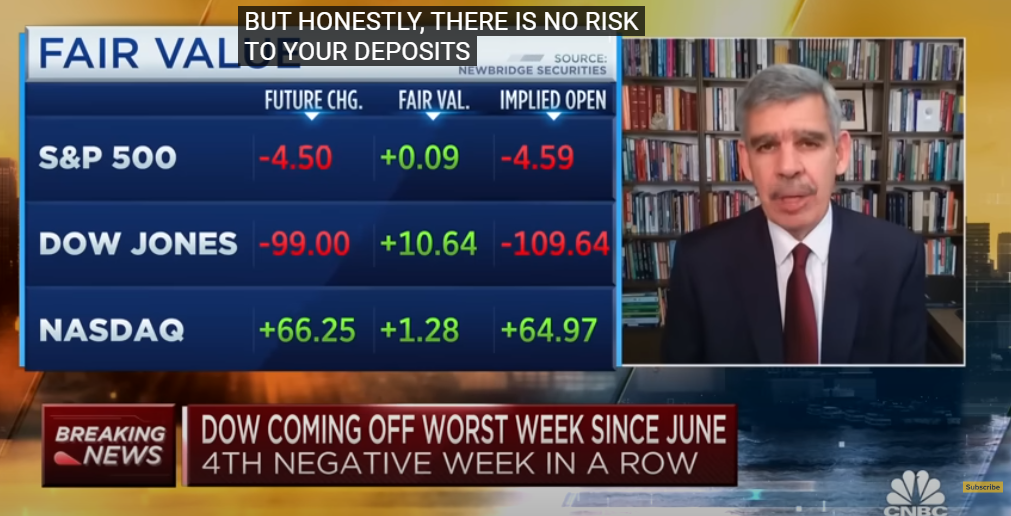
Mohamed El-Erian on BTFP guaranteeing uinsured deposits
We're here [bank failures] basically because we had a prolonged period of overly-loose monetary policy. When it came to adjusting monetary policy, the Fed did not act fast enough and then it had to hit on the breaks. And you've heard me say over and over again, when you hit the breaks, you risk both economic and financial accidents. And we've just lived through a financial accident.
It's important to stress that depositors should not worry. Your deposits are fine. And there is no need to move your deposits... Honestly, there is no risk to your deposits anymore.
It is almost impossible now to go back on unlimited deposit guarantee.
~ Mohamed El-Erian, CNBC interview, 0:45 mark, March 13, 2023
Mar 15, 2023
Michael Lebowitz on the Fed's new BTFP facility
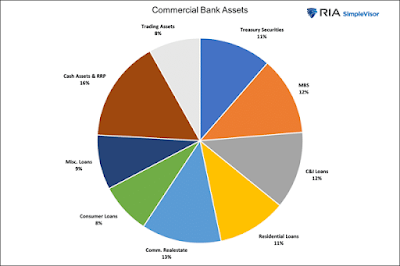
Banks sell from the pies in the chart above [loans, Treasury securities, MBS, trading assets] to meet withdrawals. However, from an economic perspective, as we will explain, it’s not necessarily what they sell but to whom they do not lend to going forward.
Further, given the Fed’s new BTFP facility, banks are incented to hold on to Treasury and mortgage assets. As such, other asset types will be sold or, at a minimum, not added to. The other assets are loans which drive economic activity.
[...]
If banks significantly tighten standards, the Fed may be dealing with disinflationary pressures sooner than expected. Banks, not the Fed, create money as they make loans. If fewer loans are made, less money is created. Subsequently, the nation’s money supply will decline further.
Yes, we said, “further.” The year-over-year change in the money supply has declined for the first time since the Depression, as the reventure consulting graph shows. Each previous decline was met with an economic depression or financial crisis.
~ Michael Lebowitz, "Aftershock Life in the Wake of Silicon Valley Bank," Investing.com, March 15, 2023
Subscribe to:
Posts (Atom)