Showing posts with label stamps - Trans-Mississippi Exposition. Show all posts

Dec 18, 2020

Mark Twain on the Mississippi River's influence on his writing

The face of the water, in time, became a wonderful book- a book that was a dead language to the uneducated passenger, but which told its mind to me without reserve, delivering its most cherished secrets as clearly as if it uttered them with a voice. And it was not a book to be read once and thrown aside, for it had a new story to tell every day.

~ Mark Twain

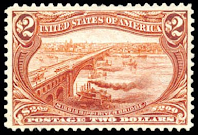
Mississippi River Bridge
1898


Pat Buchanan on Lincoln's crimes against native Americans

A renaming committee of the San Francisco school district wants the Great Emancipator’s name removed from Lincoln High School for crimes against Native Americans. 

Our 16th president ordered the Navajo tribe off their Arizona lands into New Mexico, resulting in a forced march of 450 miles. He approved the hanging of 38 Dakota Indians who had fought in the Dakota War in Minnesota in 1862, the largest mass execution in U.S. history. 

Lincoln’s Homestead and Pacific Railway acts led to the loss of large swaths of tribal lands.

~ Patrick Buchanan, "After Lee, It's Lincoln's Turn," LewRockwell.com, December 18, 2020

Indian Hunting Buffalo
1898


May 10, 2019

Financial Times: "gold is a goner" (1997)

In the western world more people are buying gold to wear, as jewellery or watches, because it makes them feel good and they can pretend to themselves that these objects will hold their value. They conveniently ignore the fact that the cost of design, production, profit and taxes usually far outstrips the value of the gold content.

But when it comes to bullion as an investment, and as a measure of national wealth, gold is a goner. The reverse alchemy is almost complete. Eddie George, governor of the Bank of England, like Fort Knox, one of the great citadels of gold, recently told a European parliamentary committee: "Whereas gold used to be seen as a good asset, it is now seen as the bottom of the pile."

~ "The Death of Gold," Financial Times cover, by Kenneth Gooding, December 13, 1997

Western Mining Prospector
1898


May 13, 2011

Ben Graham on IPOs in bull markets

Somewhere in the middle of the Bull market the first common-stock flotations make their appearance. These are priced not unattractively, and some large profits are made by the buyers of the early issues. As the market rise continues, this brand of financing grows more frequent; the quality of the companies becomes steadily poorer; the prices asked and obtained verge on exorbitant. One fairly dependable sign of the approaching end of a bull swing is the fact that new common stocks of small and nondescript companies are offered at prices somewhat higher than the current level for many medium-sized companies with a long market history. The heedlessness of the public and the willingness of the selling organization to sell whatever may be profitably sold can have only one result - price collapse.

~ Benjamin Graham, dean of the value school

Western Cattle in Storm
1898


Sep 3, 2008

Alexis de Tocqueville on the American work ethic

In the United States, as soon as a man has acquired some education and pecuniary resources, he either endeavors to get rich by commerce or industry, or he buys land in the bush and turns pioneer. All that he asks of the state is, not to be disturbed in his toil, and to be secure of his earnings.

~ Alexis de Tocqueville, Democracy in America (1835)

Image result for trans-mississippi stamps
Hardships of Emigration
1898
 

Apr 20, 2008

Agrium VP on the future of agriculture

I think the next 15 to 25 years are going to be the most exciting in agriculture history. There's an opportunity to help with the energy crisis as well as with increasing human consumption of food. 

~ Tom Warner, vice president of Agrium, a Calgary, Alberta-based agricultural products retailer, "Facing Big Changes Down on the Farm," IBD, March 3, 2008

Farming in the West
1898


Nov 3, 2007

Tom DiLorenzo on the "robber barons"

The late nineteenth and early twentieth centuries are often referred to as the time of the "robber barons."

It is a staple of history books to attach this derogatory phrase to such figures as John D. Rockefeller, Cornelius Vanderbilt, and the great nineteenth-century railroad operators — Grenville Dodge, Leland Stanford, Henry Villard, James J. Hill, and others. To most historians writing on this period, these entrepreneurs committed thinly veiled acts of larceny to enrich themselves at the expense of their customers. Once again we see the image of the greedy, exploitative capitalist, but in many cases this is a distortion of the truth.

As common as it is to speak of "robber barons," most who use that term are confused about the role of capitalism in the American economy and fail to make an important distinction — the distinction between what might be called a market entrepreneur and a political entrepreneur. A pure market entrepreneur, or capitalist, succeeds financially by selling a newer, better, or less expensive product on the free market without any government subsidies, direct or indirect. The key to his success as a capitalist is his ability to please the consumer, for in a capitalist society the consumer ultimately calls the economic shots. By contrast, a political entrepreneur succeeds primarily by influencing government to subsidize his business or industry, or to enact legislation or regulation that harms his competitors.

~ Thomas J. DiLorenzo, "The Truth About the 'Robber Barons'," Mises.org, September 23, 2006, excerpted from How Capitalism Saved America, chapter 7

Troops Guarding Train
1898