~ David Gordon, "Alexander Hamilton's poisoned legacy," Mises Wire, July 19, 2024
Showing posts with label people - Jefferson; Thomas. Show all posts
Oct 18, 2024
David Gordon on the Hamiltonian and Jeffersonian visions of America
Most readers of the Mises Wire will be familiar with the account of American history developed in many books by Mises Institute President Thomas J. DiLorenzo. According to him, American history since our founding as a nation has been shaped by two conflicting traditions: one, begun by Alexander Hamilton, favoring a centralized government and the other, best personified in Thomas Jefferson, supporting decentralized government and the rights of the states and local communities. Hamilton favored building up American industry artificially through high tariffs, as well as a national bank and a system of costly “national improvements.” He also supported high government debt to stimulate industry. Jefferson opposed all of these measures. Henry Clay’s “American System” continued the Hamiltonian plan, as did Clay’s follower Abraham Lincoln. In the twentieth century, Franklin Roosevelt’s “New Deal” fits into this paradigm.
Nov 24, 2023
Oct 10, 2022
Jun 20, 2021
Thomas Jefferson on gun control
The laws that forbid the carrying of arms are laws of such a nature. They disarm only those who are neither inclined nor determined to commit crimes…. Such laws make things worse for the assaulted and better for the assailants; they serve rather to encourage than to prevent homicides, for an unarmed man may be attacked with greater confidence than an armed man.
~ Thomas Jefferson, Commonplace Book (quoting 18th century criminologist Cesare Beccaria), 1774-1776
(Dan Ferris' quote of the week on the Stansberry Investor Hour podcast, 9:30 mark, June 17, 2021)
Apr 17, 2021
Thomas Jefferson on rebellion
Whenever any form of government becomes destructive of these ends [life, liberty, and the pursuit of happiness] it is the right of the people to alter or abolish it, and to institute new government.
~ Thomas Jefferson
Mar 15, 2021
Thomas Jefferson on education and newspapers
The man who reads nothing at all is better educated than the man who reads nothing but newspapers.
~ Thomas Jefferson
Labels:
education,
media,
newspapers,
people - Jefferson; Thomas
Nov 18, 2020
Thomas Jefferson on the dangers of fiat money
That paper money has some advantages, is admitted. But that its abuses also are inevitable, and, by breaking up the measure of value, makes a lottery of all private property, cannot be denied. Shall we ever be able to put a constitutional veto on it?
~ Thomas Jefferson
Thomas Jefferson on the contradiction of paternalistic government
Sometimes it is said that man cannot be trusted with the government of himself. Can he, then, be trusted with the government of others?
~ Thomas Jefferson
Labels:
government,
paternalism,
people - Jefferson; Thomas
Jun 23, 2020
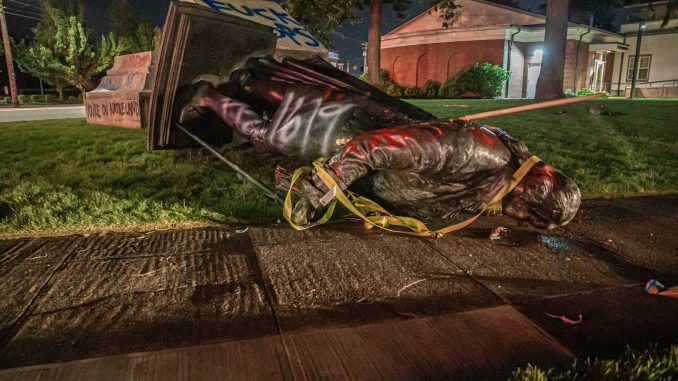
Pat Buchanan on the toppling of statues
Portland’s statue of George Washington, the Father of his Country and the first president of the United States, the greatest man of his age, was toppled and desecrated.
[...]
In Portland also, a statue of Thomas Jefferson that stood at the entrance of a high school named for the author of the Declaration of Independence was torn down. In New York, city council members demanded that the Jefferson statue in city hall be removed.
Anticipating what was coming, the New York Museum of Natural History got the permission of city hall to have the giant statue of Theodore Roosevelt astride a horse, flanked by an African and a Native American, removed from the front of the museum.
What was wrong with the 80-year-old statue?
Said museum president Ellen Futter, the problem is its “hierarchical composition.” Only Roosevelt was mounted. With Washington, Jefferson and Roosevelt all under attack, three of the four presidents on Mount Rushmore are now repudiated by the left.
Our Taliban have moved on, past Columbus and the Confederate generals, to dislodge and dishonor the Founding Fathers and their patriot sons.
~ Patrick J. Buchanan, "How Long Will the Vandals Run Amok?," LewRockwell.com, June 23, 2020

[...]
In Portland also, a statue of Thomas Jefferson that stood at the entrance of a high school named for the author of the Declaration of Independence was torn down. In New York, city council members demanded that the Jefferson statue in city hall be removed.
Anticipating what was coming, the New York Museum of Natural History got the permission of city hall to have the giant statue of Theodore Roosevelt astride a horse, flanked by an African and a Native American, removed from the front of the museum.
What was wrong with the 80-year-old statue?
Said museum president Ellen Futter, the problem is its “hierarchical composition.” Only Roosevelt was mounted. With Washington, Jefferson and Roosevelt all under attack, three of the four presidents on Mount Rushmore are now repudiated by the left.
Our Taliban have moved on, past Columbus and the Confederate generals, to dislodge and dishonor the Founding Fathers and their patriot sons.
~ Patrick J. Buchanan, "How Long Will the Vandals Run Amok?," LewRockwell.com, June 23, 2020
Jan 5, 2020
Tom DiLorenzo on how the Louisiana Purchase agitated New England secessionists
Jefferson's Louisiana Purchase infuriated the New England Federalists, who wanted America to remain as "ethnically pure" as possible. Most of them agreed with William Smith Shaw that "the grand cause of all our present difficulties may be traced... to so many hordes of foreigners immigrating to America." Given such strong feelings about ethnic purity, for New Englanders the Louisiana Purchase, which encouraged the settlement of even more "horders of foreigners" in the United States, was intolerable. Josiah Quincy was so outraged that he believed the only recourse for the New England states was secession. The Louisiana Purchase meant that "the bonds of this Union are virtually dissolved; that the States which compose it are free from their moral obligation; and that, as with be the right of all, so it will be the duty of some, to prepare definitely for a separation, amicably if they can, violently if they must."
~ Tom DiLorenzo, The Real Lincoln, p. 96
![]() |
| Map of Louisiana Purchase 1904 |
Jan 3, 2020
Thomas Jefferson on self-government
May [our Declaration of Independence] be to the world, what I believe it will be (to some parts sooner, to others later, but finally to all), the signal of arousing men to burst the chains under which monkish ignorance and superstition had persuaded them to bind themselves, and to assume the blessings and security of self-government... All eyes are opened, or opening, to the rights of man.
~ Thomas Jefferson
~ Thomas Jefferson
| Signing of Declaration 1869 |
Tom DiLorenzo on the Jeffersonian and Hamiltonian visions for America
Two of the most influential figures in American history. Two opposing political philosophies. Two radically different visions for America.
Thomas Jefferson and Alexander Hamilton were without question two of the most important Founding Fathers. They were also the fiercest of rivals. Of these two political titans, it is Jefferson—–the revered author of the Declaration of Independence and our third president—–who is better remembered today. But in fact it is Hamilton’s political legacy that has triumphed—–a legacy that has subverted the Constitution and transformed the federal government into the very leviathan state that our forefathers fought against in the American Revolution.
~ Tom DiLorenzo, Hamilton's Curse
Thomas Jefferson and Alexander Hamilton were without question two of the most important Founding Fathers. They were also the fiercest of rivals. Of these two political titans, it is Jefferson—–the revered author of the Declaration of Independence and our third president—–who is better remembered today. But in fact it is Hamilton’s political legacy that has triumphed—–a legacy that has subverted the Constitution and transformed the federal government into the very leviathan state that our forefathers fought against in the American Revolution.
~ Tom DiLorenzo, Hamilton's Curse
| Alexander Hamilton 1873 |
Jan 2, 2020
Andrew Napolitano on Abraham Lincoln
In order to increase his federalist vision of centralized power, 'Honest’ Abe misled the nation into an unnecessary war... With very little regard for honesty, Lincoln increased federal power and assaulted the Constitution. His actions were unconstitutional, and he knew it... Lincoln’s view was a far departure from the approach of Thomas Jefferson, who recognized states’ rights above those of the Union... Lincoln increased the power of the federal government at the expense of the rights of the states and civil liberties. This opened the door to more unconstitutional acts by the government in the 1900s through to today...
~ Judge Andrew Napolitano, The Constitution in Exile, Chapter 4: "Dishonest Abe: The Lincoln You Didn't Know"
![]() |
| Abraham Lincoln 1922-1925 |
Jul 14, 2019
Thomas Jefferson: "A democracy is nothing more than mob rule"
A democracy is nothing more than mob rule, where fifty-one percent of the people may take away the rights of the other forty-nine.
~ Thomas Jefferson

~ Thomas Jefferson
Apr 10, 2012
Thomas Jefferson on the tyranny of taxes
To compel a man to furnish contributions of money for the propagation of opinions which he
disbelieves and abhors, is sinful and tyrannical.
~ Thomas Jefferson
~ Thomas Jefferson
| Thomas Jefferson 1902-1903 |
Apr 18, 2010
Jefferson on legislators and natural rights
Our legislators are not sufficiently apprized of the rightful limits of their power; that their true office is to declare and enforce only our natural rights . . . and take none of them from us. No man has a natural right to commit aggression on the equal rights of another; and this is all from which the laws ought to restrain him . . . and the idea is quite unfounded, that on entering into society we give up any natural right.
~ Thomas Jefferson, letter to Francis W. Gilmer, June 27, 1816
![]() |
| Thomas Jefferson (1801-1809) 1938 |
Nov 25, 2008
Thomas Jefferson on banking and paper money
Although all the nations of Europe have tried and trodden every path of force and folly in a fruitless quest of the same object, yet we still expect to find in juggling tricks and banking dreams, that money can be made out of nothing, and in sufficient quantity to meet the expense of heavy war.
~ Thomas Jefferson, as quoted in G. Edward Griffin, The Creature from Jekyll Island, page 338
Oct 26, 2008
Thomas Jefferson on public debt
I place economy among the first and most important virtues, and public debt as the greatest of dangers to be feared.
To preserve our independence we must not let our rulers load us with perpetual debt... We must make our choice between economy and liberty or profusion and servitude.
~ Thomas Jefferson
To preserve our independence we must not let our rulers load us with perpetual debt... We must make our choice between economy and liberty or profusion and servitude.
~ Thomas Jefferson
| Thomas Jefferson 1873 |
Sep 24, 2008
Thomas Jefferson on centralized government
When all government, domestic and foreign, in little as in great things, shall be drawn to Washington as the center of all power, it will render powerless the checks provided of one government on another and will become as venal and oppressive as the government from which we separated.
~ Thomas Jefferson, Letter to Charles Hammond (1821)
| Thomas Jefferson 1922-1925 |
Sep 4, 2008
Thomas Jefferson on banking and paper money
I have ever been the enemy of banks; not of those discounting for cash [that is, charging interest on loans of real money], but of those foisting their own paper into circulation, and thus banishing our cash. My zeal against these institutions was so warm and open at the establishment of the bank of the U.S. that I was derided as a Maniac by the tribe of bank-mongers, who were seeking to filch from the public their swindling and barren gains. ... Shall we build an altar to the old paper money of the revolution, which ruined individuals but saved the republic, and burn on that all the bank charters present and future, and their notes with them? For these are to ruin both republic and individuals. This cannot be done. The Mania is too strong. It has seized by its delusions and corruptions all the members of our governments, general, special and individual.
~ Thomas Jefferson in a letter to John Adams in 1814
(Quoted by G. Edward Griffen, The Creature from Jekyll Island, page 341.)
~ Thomas Jefferson in a letter to John Adams in 1814
(Quoted by G. Edward Griffen, The Creature from Jekyll Island, page 341.)
Subscribe to:
Posts (Atom)


