Showing posts with label budget deficit. Show all posts

Apr 7, 2025

Scott Bessent: "Our trading partners have taken advantage of us"

This has been years in the making, this unsustainable system.  Our trading partners have taken advantage of us.  We can see this through the large [trade] surpluses.  We can see this through the large budget deficit.

[...]

After 20, 30, 40, 50 years of bad behavior, you can't just wipe the slate clean.

~ Scott Bessent, Treasury Secretary, "Treasury Sec. Bessent says ‘there doesn’t have to be a recession’: Full interview," NBC News "Meet the Press," 2:50 mark and 9:30 mark, April 6, 2025


Mar 16, 2025

Ray Dalio on the U.S. debt problem

Ray Dalio: I think the first thing is the debt issue.  We have a very severe supply-demand problem so that they have to sell a quantity of debt that the world is not going to want to buy.  And that's a set of circumstances that is imminent.  That's of paramount importance.  The deficit must go from what will be projected now to be about 7.2% of GDP to 3% of GDP, otherwise there will be a supply-demand problem.  That's a big deal.  You are going to see shocking developments in terms of how that's going to be dealt with, things that may not have happened in our lifetimes, but things that have happened throughout history...

Sara Eisen: What do you mean, austerity?

Ray Dalio: There may be restructurings of debt.  There may be exerting pressures on countries who own the debt, to buy the debt, political pressures on countries.  There may be cutting the payments to some creditor countries for political reasons and so on.  So there may be monetizations of debt.  If you look at history and see the repeating of "What do countries do when they're in this situation?"  There are lessons from history that repeat.  It's correct

~ Ray Dalio, "Ray Dalio and Salesforce’s Benioff on AI, trade wars and new world order," CNBC International Live, 12:00 mark, March 14, 2025


Jan 30, 2025

Ronald Reagan on balancing the budget

Ronald Reagan: When budget deficits are what's causing inflation, I don't see that there's any room to be on either side of that argument.  I think the answer to curing inflation is a balanced budget.  

Johnny Carson: Now how do you do that?  How do you balance the budget?  You don't spend more than you take in...

Reagan: Balancing the budget is like protecting your virtue.  You have to learn to say "no."

Carson: There's gotta be another way.  What's the second option?

~ Ronald Reagan, interview with Johnny Carson, The Tonight Show


Aug 4, 2022

The Economist on the 2020-21 government borrowing binge

In recent years government debt appeared to matter less and less even as countries borrowed more and more.  Falling interest rates made debts cheap to service, even as they grew to levels that would have seemed dangerous a generation before.  The pandemic put both trends into overdrive: the rich world borrowed 10.5% of its gdp in 2020 and another 7.3% in 2021, even as long-term bond yields plunged.  Now central banks are raising interest rates to fight inflation and public debt is becoming more burdensome.  Our calculations show that government budgets will feel a squeeze far more quickly than is commonly understood.


Apr 7, 2021

Howard Marks: Do the debt and deficit still matter?

Q: Do you think that the debt and deficit still matter?

A: I find it hard to believe they don't.  It's like saying that we have a credit card - the United States has a credit card - with an infinite balance capability and you never have to pay it off.  It sounds too good to be true.  And if someone offered me that credit card, I would be looking for the catch.

~ Howard Marks, "Oaktree's Marks Says This Is the Time to Try to Be Resourceful," 8:45 mark, Bloomberg TV, April 5, 2021


Nov 6, 2020

David Stockman on the effect of trillion dollar deficits on interest costs

[H]ere’s the thing.  Under any circumstance, these now guaranteed double-digit annual deficits (i.e. $2 trillion plus at current GDP levels) aren’t sustainable because compounding interest expense eventually sends the ship-of-state into the fiscal drink.

~ David Stockman, "Gridlock is Good - Except in the Jaws of Massive Public Debts," LewRockwell.com, November 6, 2020


Oct 24, 2020

David Kelly on the death of budget deficit hawks

The species has died. The 2017 Tax Act proved that you couldn't call the Republicans exactly deficit hawks. And I certainly don't think you could characterize [House Speaker] Nancy Pelosi as a deficit hawk.

~ David Kelly, chief global strategist, J.P. Morgan Asset Management, October 23, 2020

(As quoted in Streetwise section of Barron's on October 24, 2020)


Sep 20, 2020

Steve Mnuchin: "Now is not the time to worry about shrinking the deficit"

Now is not the time to worry about shrinking the deficit or shrinking the Fed balance sheet. There was a time when the Fed was shrinking the balance sheet and coming back to normal. The good news is that gave them a lot of room to increase the balance sheet, which they did. And I think both the monetary policy working with fiscal policy and what we were able to get done in an unprecedented way with Congress is the reason the economy is doing better. 

~ Treasury Secretary Steve Mnuchin, interview on CNBC’s "Squawk Box” from the White House, September 14, 2020


Jun 23, 2020

Robert Murphy on Stephanie Kelton’s new book 'The Deficit Myth'

Stephanie Kelton’s new book The Deficit Myth does a very good job explaining MMT to new readers. I must admit that I was pleasantly surprised at how many different topics Kelton could discuss from a new view, in a manner that was simultaneously absurd and yet apparently compelling.

The problem is that Kelton’s fun book is utterly wrong. The boring suits with their standard accounting are correct: it actually costs something when the government spends money. The fact that since 1971 we have had an unfettered printing press doesn’t give us more options, it merely gives the Fed greater license to cause boom/bust cycles and redistribute wealth to politically connected insiders.

~ Robert Murphy, "A Review of Stephanie Kelton's The Deficit Myth," Mises.org, June 23, 2020

deficit mmt money fed spending

Apr 15, 2020

Committee for a Responsible Federal Budget projects a $3.8 trillion budget deficit

The fiscal 2020 deficit that needs to be funded will be four times as large as last year’s at $3.8 trillion, or almost 19% of gross domestic product, according to the Committee for a Responsible Federal Budget, a non-partisan group. While few in Washington see a need to prioritize fiscal prudence right now, given the economic damage being done by the virus, the CRFB warns that an unsustainable situation is brewing and corrective actions will be needed one day.

~ "Larry Kudlow's War Bonds Are Coming But in a Plain Vanilla Rapper," Bloomberg, April 15, 2020

COMMITTEE FOR A RESPONSIBLE FEDERAL BUDGET - GuideStar Profile

Mar 18, 2020

Kevin Duffy on investing in Treasury bonds

Anyone who would loan money to the U.S. government at 1.55% for the next 30 years needs to have their head examined.

~ Kevin Duffy, "March Madness," LewRockwell.com, March 16, 2020


Feb 11, 2020

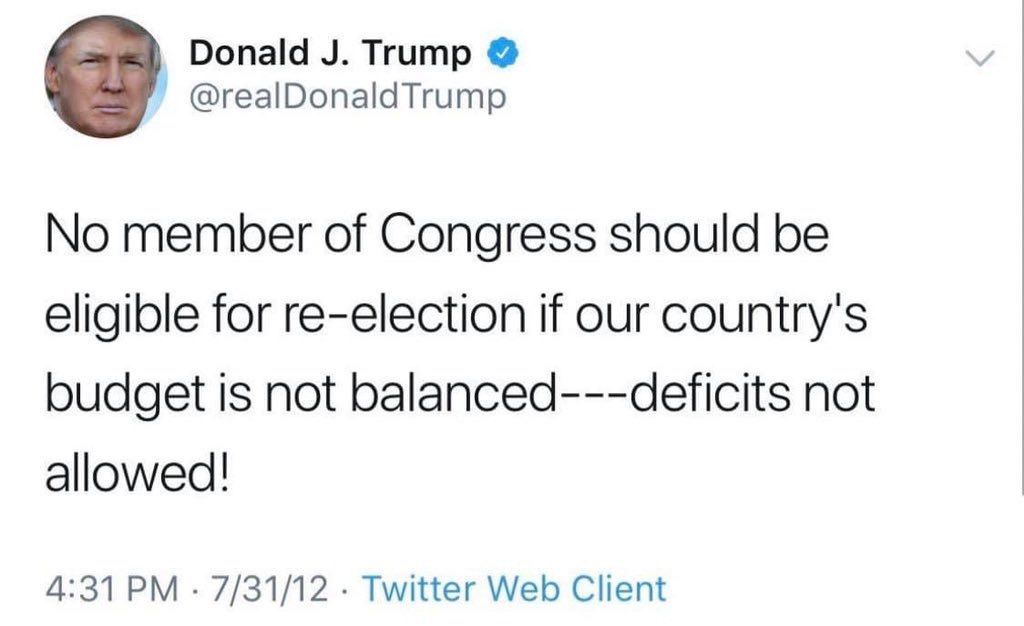
Donald Trump on budget deficits

No member of Congress should be eligible for re-election if our country's budget is not balanced --- deficits not allowed!

~ Donald Trump, Twitter, July 31, 2012

(The federal budget deficit was $586 billion when Trump was inaugurated president in January, 2017.  Today it stands at $1.022 trillion.)

Image

Jan 31, 2020

Stephanie Kelton: "We could safely increase the deficit by another $500 billion"

We could safely increase the deficit, let’s say by another $500 billion or so, before we begin to see inflation accelerating to something that we would consider problematic.

~ Stephanie Kelton, professor at Stony Brook University in New York and economic adviser to the Bernie Sanders presidential campaign, interview with Erik Schatzker, Bloomberg TV, January 30, 2020

(Kelton cited research by investment firm GMO for the numbers.)

Image result for stephanie kelton bloomberg tv"

Jun 15, 2013

Jim Paulsen on the budget deficit: "laissez faire is taking care of that problem"

[F]or the last four years or more, people have avoided the stock market because of perceived fiscal woes that are overwhelming.  I think laissez faire Adam Smith is taking care of that problem all its own.  We've had deficit-to-GDP ratio that was 10.5% at the end of the '08 recession.  It's now maybe 5.5%.  It's sort of just melting away by about 1% a year, and government really hasn't done that.  It's just been a slow revitalization of economic growth, which is raise tax receipts faster than people appreciated and lower welfare outlays.  And I think that's going to continue.  I wouldn't worry about the deficit so much.

~ Jim Paulsen, Wells Capital Management, as appeared on CNBC (quote starts at 3:13 on video), June 10, 2013

Apr 20, 2011

Ben Stein says it's bad out there, but the forecasting accuracy of S&P is questionable

I think what we're seeing is the chickens coming home to roost. We had excessively large tax cuts in the Bush-era, I don't blame them for cutting taxes in the early stages of his administration, but once the economy recovered fully, he should've raised taxes again. We've had wild overspending under Mr. Obama without any clear results from it. So, the combination of too low taxes, too much spending, has just been a disaster and the disaster is getting worse.

We have a hundred percent ratio, roughly a hundred percent, of the debt to the GDP. That has not happened since 1945. After that, we got rid of that enormous ratio by inflation and by the economy growing and the deficit stopped. The deficits are stretching out as far as the eye can see. There's no end to them in sight. So, it is a worrisome situation.

On the other hand, to strike a little lighter note, in terms of the accuracy of the S&P's predictions, they're also the ones who said there were no problems with the mortgage-backed securities. So, we don't know whether there as good at forecasting these things as they say.

~Ben Stein, actor, author and economist, WSJ's Markets Hub, April 19, 2011

Oct 23, 2010

Independent Senate Candidate Warren Mosler Bets $100M Federal Government Can Not Run Out Of Money

I am running for U.S. Senate to see my policies implemented to create the 20 million jobs we need. And to do this it must be understood that there is simply no such thing as the U.S. Federal government running out of money, nor is the Federal government operationally dependent on borrowing from China or anyone else. U.S. states, individuals, and companies can indeed become insolvent, but U.S. government checks will never bounce.

Yes, large Federal deficits that push the economy beyond the point of full employment can lead to inflation or currency devaluation, but not bankruptcy and not bounced checks. If lawmakers today understood this fact, they would not be looking to cut Social Security and we would not still be mired in this disastrous recession.

~Warren Mosler, Connecticut Independent candidate for US Senate, "Senate Candidate Bets Congress $100 Million That the U.S. Government Cannot Run out of Money", BusinessWire.com, October 23rd, 2010

May 3, 2010

Warren Buffet on large government deficits

It's certainly hard to imagine deficits like we've [the USA] been running, or like other countries have been running, being consistent with low interest rates over time. If you could really run deficits of 10% of GDP and not have anything bad happen, people would've figured that out a long time ago, because it's too much fun to do. There will be a price to be paid for the medicine we used to break out of our panic situation.

Who wants to lend money to someone who has a long-term policy of running deficits at 10%? It's unsustainable over time.

~Warren Buffett, Goldman Sachs investor, "The Buffett Express", CNBC's Squawk Box, May 3rd, 2010

Oct 6, 2008

Keynes on government deficits and taxation

It is common to speak as though, when a Government pays its way by inflation, the people of the country avoid taxation. We have seen that this is not so. What is raised by printing notes is just as much taken from the public as is a beer-duty or an income-tax. What a Government spends the public pay for. There is no such thing as an uncovered deficit.

~ John Maynard Keynes, famous British economist, in his Tract on Monetary Reform published in 1923

Oct 21, 2007

Lamm on government deficits

Christmas is the time when kids tell Santa what they want and adults pay for it. Deficits are when adults tell government what they want and their kids pay for it.

~Richard Lamm

Ewing on government deficits

The government deficit is the difference between the amount of money the government spends and the amount it has the nerve to collect.

~Sam Ewing