Showing posts with label AI capex boom. Show all posts

Jun 18, 2026

Grant's on how CEOs of AI builders see massive demand swamping supply

Open before us is page 8 of the June 8 edition of The Transcript, a weekly roundup of earnings-call excerpts.  The first quotation, from Lip-Bu Tan, CEO of Intel Corp., sets the tone for what follows: "We see token usage exploding.  Agent now consumes 1,000x more tokens than single-event reasoning."

Sundar Pichai, CEO of Alphabet, Inc., is next: "[W]e are experiencing strong demand for our AI solutions from enterprises and consumers, at levels that are meaningfully exceeding our available supply."

He is followed by the CEO of Microsoft Corp., Satya Nadella: "[W]e are supply-constrained...  The thing that we do not want to do is to disappoint especially our enterprise consumers on Azure."

Then comes Jeffrey Clarke, COO of Dell Technologies: "Demand continues to exceed supply with memory as the primary constraint, and we expect to exit the year with meaningful backlog."

And not to forget Jensen Huang, CEO of Nvidia Corp.: "[W]e don't have enough supply.  The reason for that is because the world supply chain is supply-constrained.  We have the support of our ecosystem to have very robust growth, and well in support of whatever guidance we've provided."

Finally appears the CEO of Cerebras Systems, Inc., Andrew Feldman: "What is unusual about AI right now is the builders are so far behind the demand, it's absurd.  We have a backlog of more than $2 billion of demand...  [N]one of us, not us, not AMD, not Nvidia, can keep up with the demand that your employees are driving.  And that's sort of, in a lot of ways, the opposite of a bubble.  We are chasing, right?  Our customers and their customers are moving at the speed of software, and we're moving at the speed of real estate, data centers, right?  Um, and so we are behind."

~ Grant's Interest Rate Observer, "Hanging by a stock price," June 19, 2026
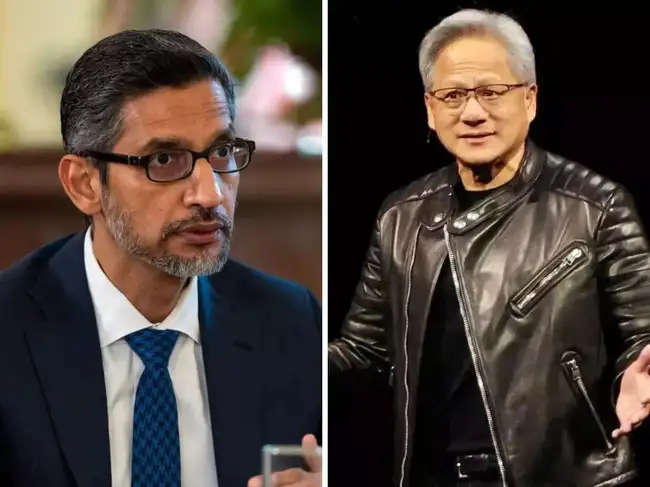
Pichai and Huang 

Jun 16, 2026

Evan Lorenz on DeepSeek's latest model, V4

Evan Lorenz: In January 2025, DeepSeek released its R1 model, which offered comparable performance to the best Western chatbots at a fraction of the price.  As Western investors digested the news of cut-rate, Chinese competition, the Nasdaq sold off.

Grant's: Mr. Market is turning a blind eye so far to the recent unveiling of DeepSeek's latest model, V4.  Like R1, V4 slightly underperforms the leading Western competition but sells at a fraction of the Western cost.  Bloomberg explains how: "DeepSeek's trillion-parameter system uses the Mixture-of-Experts technique, selectively triggering only a small subset of experts and activating only up to 37 billion parameters per task to keep inference costs far lower than for similar frontier models."

DeepSeek has put its model up for sale at 75% off until the end of the month, but once that discount ends, V4 will cost between just one-tenth to one-quarter of the leading American equivalents.

Lorenz: Price competition is what just might deflate the high-cost and capital-intensive AI boom.

~ Evan Lorenz, "The way the boom ends," Grant's Interest Rate Observer, May 8, 2026

🚀 🚨 Stop Everything — DeepSeek V4 Might Be the Smartest Coding AI of 2026  | by Greek Ai | GoPenAI 

OpenAI's CFO: "We are facing a vertical wall of demand"

Right now we are facing a vertical wall of demand.  If there are areas where we are not achieving certain goals, I would say it is often the lack of computational capacity that is slowing us down to some extent. 

~ Sarah Friar, OpenAI chief financial officer, Bloomberg interview, "OpenAI: We see a vertical wall of demand for our products," 24 ORE, May 1, 2026

Sarah Friar Bloomberg 

May 25, 2026

Dario Perkins on the AI capex debate

With U.S. tech stocks melting higher, the bulls are clearly “winning.” Two forces are driving this revival in sentiment. First, revenues across the AI ecosystem have surged, which seems to contradict the bears’ worries about data-center profitability. Second, we are seeing extremely strong demand for compute, which helps to alleviate investors’ worries about “overinvestment.” 

From our perspective, however, the debate about the sustainability of AI capex hasn’t been settled. Far from it. That’s because what we are seeing now is still largely just the result of revenue recycling, rather than the entry of new funds from outside the AI ecosystem. 

To illustrate: This year the hyperscalers are set to spend around $700 billion on data centers. That is a huge sum. Not only does it directly boost the revenues of the companies that provide the infrastructure, but the hyperscalers are also booking revenues from the recycling of those investments, either as order backlogs (“commitments” from the likes of OpenAI) or as “other revenues” (derived from the hyperscalers taking an equity stake in their customers and then recording large capital gains). 

Meanwhile, it is the model developers and the hyperscalers that are still driving much of the increase in demand for compute, as they put those massive AI investments to work. This whole ecosystem is massively circular; and while those circular dynamics clearly have a lot of momentum, that, in itself, isn’t enough for medium-term sustainability. For AI capex to be sustainable over the medium term, there needs to be a much larger share of revenue (and compute demand) from outside the ecosystem, particularly from business and consumer demand. Capex recycling isn’t enough. 

~ Dario Perkins, "The AI capex debate—who is right?," Macro Picture/TS Lombard, May 21, 2026

Fade Trump Chaos Until The Tipping ...