~ John V. Denson
Showing posts sorted by date for query john denson. Sort by relevance Show all posts
May 29, 2024
John Denson: "The twentieth century was the bloodiest in all history"
The twentieth century was the bloodiest in all history. More than 170 million people were killed by government with 10 million having been killed in World War I and 50 million killed in World War II. Of the 50 million killed in World War II, nearly 70 percent were innocent civilians.
Nov 28, 2023
Ralph Raico on Winston Churchill's love of war
But while Winston had no principles, there was one constant in his life: the love of war. It began early. As a child, he had a huge collection of toy soldiers, 1500 of them, and he played with them for many years after most boys turn to other things. They were "all British," he tells us, and he fought battles with his brother Jack, who "was only allowed to have colored troops; and they were not allowed to have artillery." He attended Sandhurst, the military academy, instead of the universities, and "from the moment that Churchill left Sandhurst … he did his utmost to get into a fight, wherever a war was going on." All his life he was most excited—on the evidence, only really excited—by war. He loved war as few modern men ever have—he even "loved the bangs," as he called them, and he was very brave under fire.
In 1925, Churchill wrote: "The story of the human race is war." This, however, is untrue; potentially, it is disastrously untrue. Churchill lacked any grasp of the fundamentals of the social philosophy of classical liberalism. In particular, he never understood that, as Ludwig von Mises explained, the true story of the human race is the extension of social cooperation and the division of labor. Peace, not war, is the father of all things. For Churchill, the years without war offered nothing to him but "the bland skies of peace and platitude." This was a man, as we shall see, who wished for more wars than actually happened.
When he was posted to India and began to read avidly, to make up for lost time, Churchill was profoundly impressed by Darwinism. He lost whatever religious faith he may have had—through reading Gibbon, he said—and took a particular dislike, for some reason, to the Catholic Church, as well as Christian missions. He became, in his own words, "a materialist—to the tips of my fingers," and he fervently upheld the worldview that human life is a struggle for existence, with the outcome the survival of the fittest. This philosophy of life and history Churchill expressed in his one novel, Savrola. That Churchill was a racist goes without saying, yet his racism went deeper than with most of his contemporaries. It is curious how, with his stark Darwinian outlook, his elevation of war to the central place in human history, and his racism, as well as his fixation on "great leaders," Churchill's worldview resembled that of his antagonist, Hitler.
~ Ralph Raico, "Rethinking Churchill," The Costs of War: America's Pyrrhic Victories, by John Denson
Nov 4, 2007
Teddy Roosevelt on executive power
Whenever I could establish a precedent for strength in the executive, as I did for instance as regards external affairs in the case of sending the fleet around the world, taking Panama, settling affairs of Santo Domingo and Cuba; or as I did in internal affairs in settling the anthracite coal strike, in keeping order in Nevada this year when the Federation of Miners threatened anarchy, or as I have done in bringing the big corporations to book - why, in all these cases I have felt not merely that my action was right in itself, but that in showing the strength of, or in giving strength to, the executive, I was establishing a precedent of value.
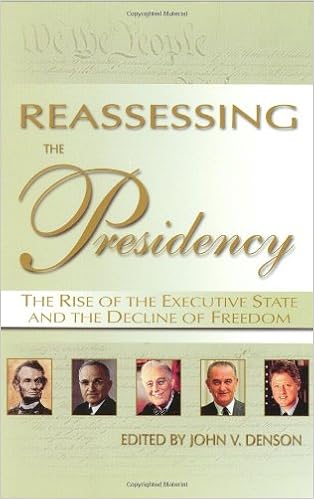
~ President Theodore Roosevelt, as quoted in Reassessing the Presidency: The Rise of the Executive State and the Decline of Freedom, p. 361, John V. Denson, editor
Historians
Statists:
- Boot, Max (CFR, 1969-, profile)
- Schlesinger, Arthur Jr. (profile)
Anti-statists:
- de Tocqueville, Alexis (1805-1859, profile)
- Denson, John
- DiLorenzo, Thomas
- Higgs, Robert (1944-, profile)
- Lord Acton (1834-1902, profile)
- Raico, Ralph (profile)
- Tuchman, Barbara (1912-1989, profile)
- Woods, Thomas (1972-, profile)
Neutral:
- Durant, Will
- Johnson, Paul (1928-, profile)
Oct 25, 2007
John Denson on Teddy Roosevelt
[Jim] Powell [author of Bully Boy: The Truth About Theodore Roosevelt's Legacy] states that "Theodore Roosevelt believed war was glorious, even healthy for a nation. He thought that reasons for participating in war should not be limited to national defense. He insisted that the United States should intervene in affairs of other nations and enter into other people’s wars to do good." Powell further states that T.R. "Claimed that war would make better men and a better world. He longed for the excitement of war as he showed clearly in the Spanish-American War, when he resigned from his position as assistant secretary of navy to enter the fighting and secure a measure of glory." Powell reveals the fact that T.R. actively lobbied to obtain the Congressional Medal of Honor, but was denied this because he only served for two weeks and his "exploits were limited to a single day. More than a century later Roosevelt was awarded the Medal of Honor posthumously by President Bill Clinton." Powell goes further by quoting T.R. "No triumph of peace is quite so great as the supreme triumphs of war."
Powell’s book points out the aggressive measures of T.R. in gaining Federal control of the economy in order to eliminate the free market. Powell states, "Theodore Roosevelt claimed that politicians and bureaucrats could achieve fairness by interfering with the economy." He "never recognized the fatal flaw of giving a few people enormous power over the entire economy." Powell points out that it was T.R. who introduced his slogan, "The New Nationalism" by which he meant, "Executive power as the steward of the public welfare." T.R. believed that it was within the president’s power "not only his right but his duty to do anything that the needs of the nation demanded unless such action was forbidden by the constitution or by the laws."
Powell quotes T.R. as stating, "I am a Hamiltonian in my governmental views, especially with reference to the need of the exercise of broad powers by the national government." I believe that if you connect the dots you will see a straight line from Hamilton to Henry Clay to Lincoln to T. R. to Wilson and finally to FDR. All of these politicians believed that the federal government should be in control of the economy but certain businesses should be favored by a partnership with the government through subsidies and other benefits.
~ John V. Denson, "American Mussolini," LewRockwell.com, October 25, 2007
Subscribe to:
Posts (Atom)