Jan 19, 2023

Jane Fraser sees a "mild, manageable" recession

I think everyone's converging now in the States more around a mild, manageable recessionary scenario driven by the strength that we've got in the labor markets.

[...]

The vulnerabilities you normally expect heading into slower economic growth don't exist at the moment: strong corporate balance sheets, strong consumer balance sheets and banks in very good health as well.

~ Jane Fraser, Citi CEO, CNBC interview in Davos, 1:55 and 2:55 mark, January 17, 2023


Bernard Baruch on the stock market

Above all else... the stock market is people.  It is people trying to read the future...  What drives the prices of stocks up and down is not impersonal economic forces or changing events, but the human reactions to these happenings...  Th main obstacle lies in disentangling ourselves from our own emotions.

~ Bernard Baruch


Larry Summers: "soft landings are the triumph of hope over experience"

I'm still cautious, David, but with a little more hope than I had before.  Soft landings are the triumph of hope over experience, but sometimes hope does triumph over experience.  We have seen some slowing of inflation indicators  at the same time we've seen continued strength [in the economy].  That's gotta be what we all want to see.  I still think it's gonna be hard because we need a substantial amount of disinflation that goes beyond volatile components receding, but you have to recognize that the figures are better than somebody like me would've expected three months ago.  So it’s still a very, very difficult job for the Fed, but the situation does look a bit better.  

~ Larry Summers, interview with David Westin in Davos, Bloomberg Television, January 18, 2023


Jan 18, 2023

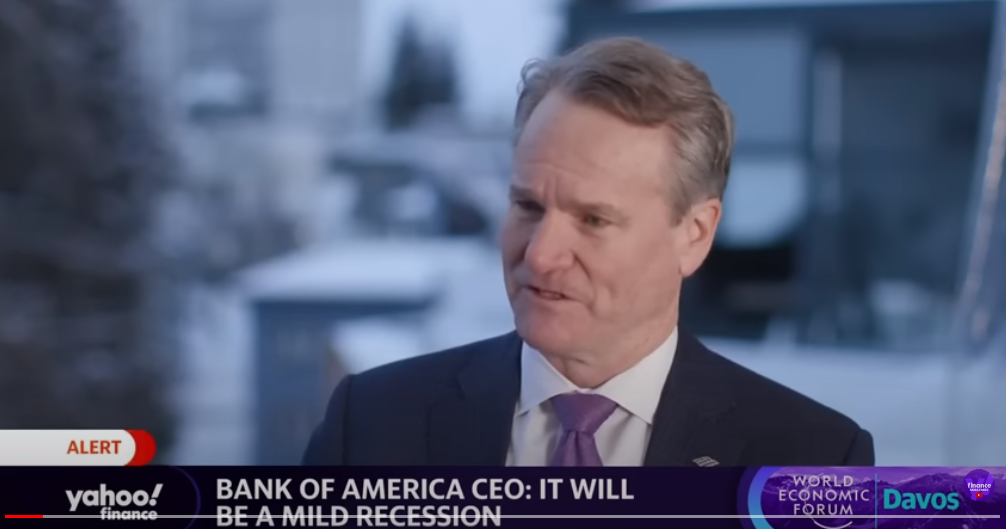
Brian Moynihan: "It'll be a mild recession"

It'll be a mild recession, largely because the stimulus and other things, even though the Fed's raised rates, you see the capacity of the American consumer to keep going.  So basically a mild recession early next year.  But over the last year that's been constantly pushed out so we'll see what happens, but mild recession, slightly down for a couple of quarters and then back to slightly up and then more normal in '24 and into '25.

~ Brian Moynihan, CEO if Bank of America, Yahoo!Finance interview from Davos World Economic Forum, 0:15 mark, January 17, 2023


Craig Mellow on the Japan-China trade relationship

Beijing is Tokyo's largest trading partner, with bilateral trade clocking in at $164 billion last year...

"Japan can't survive economically without China's business, even if it's becoming more difficult to continue business as usual," says Shigeto Nagai, head of Japan economics for Oxford Economics.

Japan Inc. has tried to diversify...  But investment has shifted only marginally to lower-cost Asian nations like Thailand and Vietnam.

[...]

Mutual advantage leads to profit.  Japanese foreign direct investments in China returned 15% annually from 2015-20, compared with 6% in North America, Oxford Economics found.  The yen's 20%-plus plunge against the dollar over the past year will squeeze those American returns further.  Japanese executives, not surprisingly, name China as their top pick for future FDI.

[...]

Tokyo took a decoupling step of its own in April, pass the Act for the Promotion of Ensuring National Security Through Integrated Implemenation of Economic Measures.

[...]

Japan Inc. isn't so quietly pushing back.  "The accumulation of business activities over many years serves as a key foundation that supports bilateral trade," Masakazu Tokura, chairman of the famed Keidanren business lobby, told Chinese Premier (since deposed) Li Keqiang in an online meeting last month.

"In the U.S., a hard line in China has been a political unifier," notes Shihoko Goto, director for Indo-Pacific enterprise at the Wilson Center.  "In Japan, it has become a divisive issue."

~ Craig Mellow, "For Japan, Breaking Up With China Is Hard to Do," Barron's, October 29, 2022


Eric Johnston on using the unemployment rate as a contrary indicator

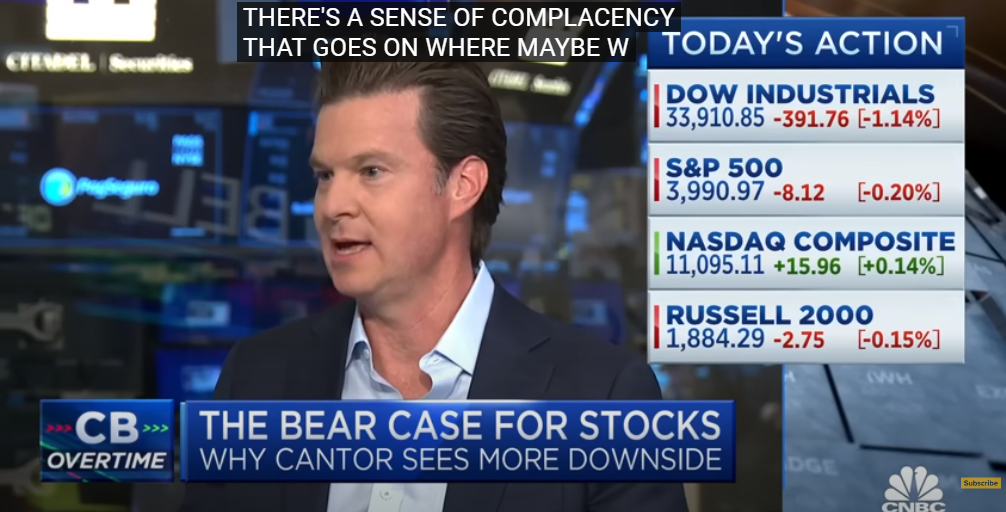
If you look at the past selloffs in the market, they've all started with a very low unemployment rate.  So February of 2020?  That was a 50-year low unemployment rate.  2007?  That was a 6-year low unemployment rate.  In the bubble of 2000, everything felt great in February of 2000.  We were at a 30-year low unemployment rate.  Things felt great and then... things completely fell apart.  So in the beginning of these things, there's a sense of complacency that goes where "maybe we can get through this."  But the reality is, is that it always feels this way in the beginning.  We go in cycles and I think over time, if you sold a 3 1/2% to 4 1/2% unemployment rate and you bought a 10% unemployment rate, you would do very well.  And right now we are towards the end of the cycle, and whether the cycle ends in 2023 or '24, it's probably on its last legs.

~ Eric Johnston, Cantor Fitzgerald, CNBC interview with Scott Wapner, 2:20 mark, January 18, 2023


Jan 17, 2023

Paul Wong on how China benefits from the West's energy policy of ESG and sanctions

Since the peak of the last secular bull market in commodities in early 2011, chronic underinvestment driven by cyclical factors and attention to ESG concerns (environmental, social and governance) have created structural supply shortages and tighter supply-demand balances than prior investment cycles.  And now, spillover from sanctions has taken a bigger bite from the supply.  For example, the U.S. has sanctioned countries accounting for 40% of the world's oil reserves (Russia, Iran and Venezuela), resulting in much of this oil trade flow going to China at steep discounts.  Furthermore, China continues to make inroads with the GCC (Gulf Cooperation Council, an economic union of six oil producers, notably Saudi Arabia, UAE, Kuwait, etc.) for long-term oil purchases and investment in its upstream sectors (refining, storage, transportation, etc.).  The GCC accounts for another 40% of the world's oil reserves.  Facilities for settlement systems have been created (or nearly) for renminbi (RMB) settlement,10 currency swaps and foreign exchange transaction systems.  In short, we appear to be in the early days of an emerging "petroyuan" and another step in long-term de-dollarization.

~ Paul Wong, "2023 Top 10 Watch List," Sprott Monthly Report, January 9, 2023