Jan 9, 2023

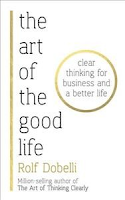
Rolf Dobelli on the challenge of youth

Our sample sizes are too small, our decisions rushed - or, in the language of statisticians, not representative.  We rely on a false impression of reality, believing that with a few random spot tests we can find the man or woman of our dreams, our ideal job, the best place to live.  Sure, it might work out - if so, then I'm thrilled for you - but if it does, it will only be by a stroke of good fortune, and nobody should pin their hopes on that.

The world is much bigger, richer and more diverse than we imagine, so try to take as many samples as you can while you're still young.  Your first years of adulthood aren't about earning money or building a career.  They're about getting acquainted with the universe of possibility.  Be extremely receptive.  Taste whatever fate dishes up.  Read widely, because novels and short stories are excellent simulations of life.  Only as you age should you adapt your modus operandi and become highly selective.  By then you'll know what you like and what you don't.

~ Rolf Dobelli, The Art of the Good Life, "The Secretary Problem," pp. 192-193


Benjamin Franklin on war, peace and self-improvement

Be at war with your vices, at peace with your neighbors, and let every new year find you a better man.

~ Benjamin Franklin


Jan 5, 2023

Horizon Kinetics: indexation and asset allocation models are broken

Investors now face questions they haven’t had to consider for decades.  Until this past year, the entrenched basketof-securities approach to investing meant one didn’t have to think, one just bought the recommended asset classes.  That approach is now in disarray.  It depended on a simplistic presumption that the prior 20 or 40 years of daily price data represented normality.  It couldn’t contemplate a change in those presumptions.  History is a lot messier.  That data, it turns out, described an anomalous period, not a normative one. 

It should now be clear that indexation and asset allocation models – at least as practiced – can no longer be relied upon as having predictive value.  Bonds, for instance.  Over the past 20 years, after taxes, they returned only about 2%, annualized.  Even accepting the government’s CPI calculation that inflation averaged only 2.5%, that means bonds had a negative real return, a two-decade loss of purchasing power.  That was not supposed to happen (on the reasoning that it hadn’t happened before).  And that was during a period of relatively benign inflation.  ‘Benign’ is not the likely caption for the next 20 years.  Rationally, one must rethink one’s approach to bond investing.  One must rethink other presumptions about the standardized approach to investing.

~ Horizon Kinetics 2023 investor letter, January 4, 2023

Murray Stahl


Dan Ferris on the complexity of markets

Just philosophically I think that people don't create markets; markets happen to human beings.  We are in markets like fish are in water and the fish don't control the tides or the wind or the waves or the currents or the temperature or any of that stuff.  And I don't think humans have the kind of control over markets that they purport or that many people believe, like the Fed.  They think the Fed controls the market and make it go up and down by lowering or raising rates.  And I don't think it works that way.  I think the market is going to do what it does.  It's extremely complex.  It's not 3-D chess, it's a million-D chess every day, and there are too many inputs, it's too complex, we can't control it, we can only participate in it.

~ Dan Ferris, "Top 10 Potential Surprises for 2023," Stansberry Investor Hour, 47:25 mark, January 4, 2023


Naval Ravikant on reading

Reading a book isn't a race - the better the book, the more slowly it should be absorbed.

~ Naval Ravikant


Jan 3, 2023

Evan Lorenz on rising interest expense for the U.S. government

According to the White House's Office of Management and Budget, the United States paid an average of 1.5% on its obligations in the fiscal year ended Sept. 30, down from 1.6% in 2021 and 2.1% in 2012.  If we were to mark the $24.4 trillion of public debt outstanding to a 4% yield, interest expense would soar to $975.5 billion from the $357.1 billion paid last year.  The difference between those two figures - $618.3 billion - is not so far from the $779.7 billion defense budget.

Thankfully for Uncle Sam, interest rates do not reset overnight (and for that matter, too, they sometimes go down).  As of June 30, the average maturity on marketable Treasurys was 74.3 months, with 49% of debt maturing in three years or more.

~ Evan Lorenz, "Twisting in the wind," Grant's Interest Rate Observer, November 11, 2022


Jan 2, 2023

Jeff Bezos on passion

If you don't love your work, you're never going to be great at it.

~ Jeff Bezos